Showing posts with label Dashiell Hammet. Show all posts

Saturday, November 5, 2016

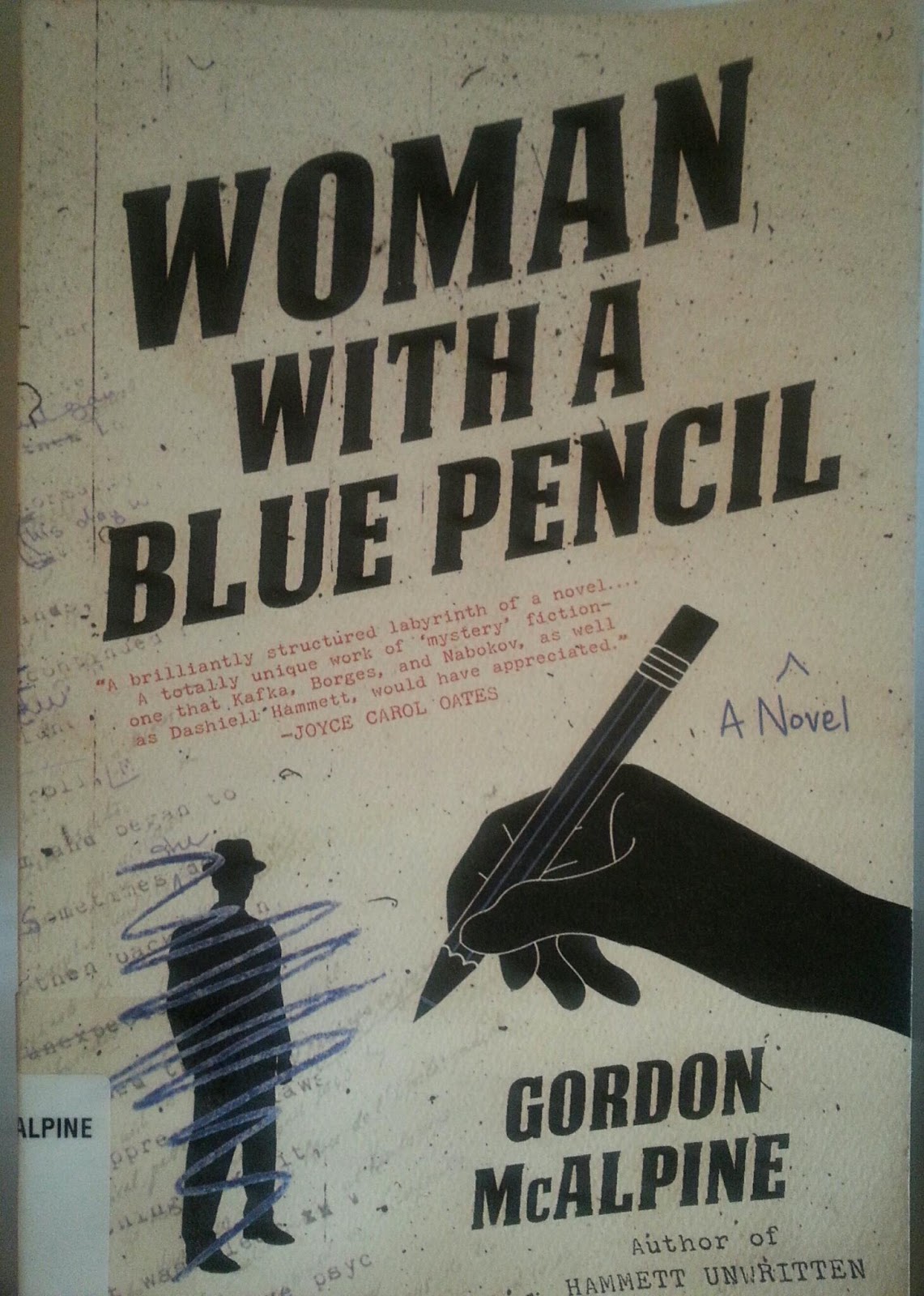
"Woman With A Blue Pencil" by Gordon McAlpine

Takumi Sato wanted to write a mystery novel about a grieving husband seeking his wife's lover/killer. His editor at the publishing house, Maxine Wakefield, would prefer a genre spy adventure about a secret agent tailing an assassin. Sam Sumida is a Japanese-American professor who fears he is losing his grip on reality: there is no record of his existence anywhere. Police detective Henry Czernicek is Sam's only connection to the world he remembers...but this guy is the man who was having the affair with Kyoko, Sam's wife..and is the man who killed her..maybe..a woman resembling Kyoko is running loose on the streets in a killing spree. In hot pursuit is Korean-American secret agent Jimmy Park, who hates being confused with Japanese by ignorant Whites, though is not particularly interested in identifying anything about Korean culture that would make him as distinctly different from a Japanese man (or any American man, for that matter) as he claims he is.

Gordon McAlpine - he wrote Hammett Unwritten under the pen-name "Owen Fitzwilliam - juggles all these characters and stories using mixed-narration and multiple realities. I'm reminded of Rosencrantz and Guildenstern Are Dead or "The Zeppo" episode of Buffy or The Lion King 1 & 1/2, where you have a separate story occurring in the background/periphery of a more commonly-known story brought up to the foreground. Takumi Sato, a 22 year-old Japanese-American man languishing in an internment camp during World War II, completes his manuscript for The Orchid and The Secret Agent per Maxine Wakefield's specifications, but only because he decides he will finish the story he really wanted to tell by having Sam and Henry find their footing in this forced, cardboard reality of a rubbish spy novel that Maxine manipulates Takumi into writing.

The book isn't perfect - the only characters that feel fleshed out are Sam and Henry..and perhaps the point of the book is that the characters with the most capacity for life get to finish their story. Jimmy Park is a secret agent/detective who accomplishes nothing beyond beating up a bunch of guys. Takumi Sato completes a book he didn't want to write, only because he found a way to complete the book he wanted to write, but felt doomed by circumstances surrounding him and saw no future in his current state. Maxine Wakfield got the novel she wanted to publish, but will never get to spin it into a series, because she twisted the arm of her writer too hard. Sam Sumida finally got revenge against his wife's killer, but his wife doesn't exist anymore and was revised into a twisted new character that is emphatically not the Kyoko he knew and loved. Only Henry Czernicek got what he deserved..even if what he deserved only mattered because it mattered to two different men living on two different panes of existence.

Even more impressive is how short the book is. There are a lot of high-concept novels out there that weigh a brick..and always read like something you've glanced at before on film or television. Not this. This was good.

Friday, October 14, 2016

"The Chocolate Falcon Fraud" by JoAnna Carl

This month marks the 75th anniversary of the 3rd adaptation of Dashiell Hammett's epic detective novel, The Maltese Falcon...the one with Humphrey Bogart and the statue of a bird. All kidding aside, The Maltese Falcon should rank among the top 2 greatest mystery novels of all time (the other being The Hound of The Baskervilles) and the film actually improves on it, particularly with the ending, which leaves out an additional scene in the book that sort-of cheapens our conclusions about the character of Sam Spade by implying that he's already over the drama, whereas the Bogart version of Spade is not likely to forget what happened after "..a couple of rough nights.." If you haven't seen it, please do.

Now...I realize the only surviving participant in the 1941 film is the prop falcon statue. There are two in existence. They both have aged to the point where they appear to be made of solid milk chocolate, in color and texture - like a chocolate bunny. Some replicas of this prop are gold-plated, so they resemble a solid chocolate falcon wrapped in gold foil..

With this train of thought in mind, it was easy for me to see the appeal of a mystery novel with a title that includes the words "Falcon" and "Chocolate". Right off the bat, I will say that there is no chocolate Maltese Falcon statue in the book, even though the protagonist specializes in designing original gourmet chocolate confections. The only chocolate falcons we get are described in a way that resembles those holiday chocolate candies Russell Stover offers - marshmallow-filled chocolates in the shape of Santa Claus, Halloween pumpkins and Easter eggs. These Falcon candies are offered by our heroine at a Maltese Falcon film festival/fan expo, a convention you might think would exist, given the popularity of the film, but is made-up for the plot of the book.

The Chocolate Falcon Fraud is a cozy - a sub-genre of mystery novel in which there's a puzzle to be solved, but it's not a tough puzzle; the real appeal is that the heroine (always a female protagonist; the closest you get to a male cozy detective series is M.C. Beaton's Hamish Macbeth novels and Lawrence Block's Bernie Rhoddenbar books, which are mostly classified as police procedural and caper novels, respectively, but Hamish is a constable in a cozy Highland village and Bernie's a thief that owns a shop, so they fit in there) runs a shop that makes gourmet chocolate with her aunt, so the author gets to better her books with recipes and trivia about fudge and chocolate foodstuffs for chocoholics. It could be adapted into a film for the Hallmark Movies and Mysteries channel. More on that in a bit, but getting back to what a cozy is...they're light in subject matter and not too explicit in violent content. It's Miss Marple and Murder, She Wrote territory, where a headline on the front page of the New York Daily News might actually read, "Murder Stymies Cops!"

Lee Woodyard is our eager amateur sleuth. Her stepson from a former marriage has come back into town to become the target of an elaborate kidnapping plot by a group of con artists baiting him with a ruse about a possible 3rd falcon prop statue used in the 1941 film that he wants to purchase. Doppelgangers for Sydney Greenstreet, Peter Lorre and Mary Astor show up. Gawdy keychain-size replicas of the falcon pop up. This is good stuff, but my big gripe (aside from the lack of a proper falcon statue made of solid milk chocolate) is that the cool Falcon riffs kick in halfway through the second half of this book. Most of what we get is teen soap opera about Jeff, the aforementioned stepson/scapegoat, whose transformation from ne'r-do-well emo teen punk to nerdy film buff/movie memorabillia tchotchke collector with a girlfriend is sincere...or if he's on the shenanigans.

The book is okay...but JoAnna Carl (a pseudonym used by Eve K. Sandstrom) dropped the ball by overlooking the most obvious gag a mystery novel with a title like that could have. It has a lot of nice ideas..I do wish there was a bigger fandom for The Maltese Falcon.

Should The Chocolate Falcon Fraud be adapted into a film for Hallmark Movies and Mysteries? Yeah! It would be terrific! I would like to suggest Danielle Harris play Lee Woodyard. I can easily picture her in a mystery involving a popular genre film, a fan convention and collectors and tchotchkes...and Will Wheaton could play her love interest, because Danielle's husband in real-life kind-of resembles Wheaton..if Wheaton was pumping iron a bit. And Jennifer Tilly could play Lee's Aunt Nettie, so yeah, this would be awesome.

And there will be a falcon statue made of solid milk chocolate..with marshmallow center, of course.

Thursday, June 30, 2016

5 Questions With...Joseph Adorno

The following questions came from David Rachels' blog, Noirboiled Notes (http://www.noirboiled.blogspot.com) I thought it would be fun to answer them; it's a recurring feature on his blog, where he sometimes posts interviews with contemporary mystery/crime fiction writers. I noticed I was able to answer some of them..

1. What's the first crime novel that you remember reading?

Encyclopedia Brown and The Case of The Mysterious Handprints. That was the first one, though if you find it too "kiddie", The Maltese Falcon was the 1st "adult/mature" crime novel I read...but I remember seeing the film first before reading the book, so I personally don't feel like counting it. The Murder At The Vicarage, then.

2. (Dashiell) Hammett or (Raymond) Chandler?

Hammett. Five novels, neither one alike. Each had something new to say. Chandler...I like Philip Marlowe, but I don't like the books..they're too formulaic to me. He rewrote The Big Sleep an additional six times. My favorite scenes in The Long Goodbye are not in the book - they're in the Robert Altman film adaptation - where Marlowe tries to seek a particular brand of cat food for his pet cat in the middle of the night, then in the end, when he shoots Terry Lennox. He thought the cat was his friend; he thought Terry was his friend; they turned on him, like he was a loser, yet he was the only one who cared about either. Meanwhile, in the books...Chandler's prose would have you think he could type 150 pages of scenes describing furnishings and call it a "novel".

3. If forced to choose, would you want Sherlock Holmes or Philip Marlowe to save your life?

Holmes. Marlowe's no fool, but he's always the last to figure out everything! As a detective, he's perceptive in small ways; he can solve the puzzle, but only after the bodies have piled up. Everyone is one step ahead of him..even the shady asshat cops that always give him a hard time and do nothing to help are one step ahead of him! Like I said earlier, I like Marlowe, but Chandler liked him as a noble sap.

4. If you were stuck on a desert island, which crime novelist's complete works would you choose to take with you?

Agatha Christie. There's a lot I have yet read. I would stack neat piles resembling furniture and point to a book like Taken At The Flood and say, "I'm going to give you another chance!"..That was the one Poirot novel that I could never get through..something dull about it...like it was written just as she was making Ms. Marple's appearances more frequent and was about to write fewer Poirot books. When he does appear in later novels, he's usually accompanied by Ariadne Oliver, a mystery writer who was a caricature of Christie's public persona as a mystery writer.

5. Any novel by Chandler you can recommend?

Pfft! ...actually, I think I have an interest in Poodle Springs that I could never shake off. He only wrote the first four chapters before he croaked; it's the work of a dying man - a crusty Philip Marlowe realizing that he's just gotten married to a vapid socialite that proposed marriage to him over the phone; it's strongly hinted that he had taken it at a week moment, when he was feeling his age, taking stock of his lonely existence...and now he realizes he doesn't want to be Nick Charles. It's was a spoof of Hammett's The Thin Man, basically. Enter writer Robert B. Parker with Chapter 5's "I finally found an office." and you realize the rest of the novel is going to eschew the Thin Man riff in favor of another Big Sleep pastiche, this time with Marlowe acting more like Spenser, For Hire...

Or I could recommend The High Window.


Monday, June 30, 2014

The Magrs Method of Book Reporting: "Hammet Unwritten" by Owen Fitzstephen (aka, Gordon McAlpine)

Encapsulate the plot of the book in one sentence?

Writer Dashiell Hammet suspects the black falcon statuette he once kept as a momento before giving it away might be a powerful talisman key to his early success...and sharp decline in his career and personal life in its absence.

What's your verdict?

Dashiell Hammet worked as a private detective for the Pinkerton Detective Agency and quit when his writing career blossomed. He did claim that the villains featured in The Maltese Falcon were based on people he encountered while on assignment at Pinkerton's, but the falcon case was pure fiction; the statuette was inspired by a jeweled skull owned by Phil Haultain,  a Pinkerton agent who worked with Hammet in the 1920s and kept it in a safe in his office.

Hammet Unwritten is a fictionalized retelling of Hammet's life, particularly the final two and a half decades, in which he seemed to be adrift, creatively,  personally and professionally. In 1934, he wrote The Thin Man, his last novel, which inspired a successful film franchise starring William Powell and Myrna Loy as Nick & Nora Charles. He contributed screen story treatments, or "scriptments" for two of the film adaptation's five sequels in the form of short novellas, but otherwise,  the remaining years of his life were spent coasting on his celebrity. He often recieved huge advances from publishers for exclusive publishing rights to future novels he would pitch (often he claimed he was working on a novel that sounded like a contemporary take on Swiss Family Robinson) and there is that strange fragment of a novel, Tulip, which was cobbled in with a collection of older short stories after his death, The Big Knockover.

In Unwritten, what we've got is a sequel to Falcon starring Hammet. Gordon McAlpine imagines Hammet's last case for Pinkerton's as "The Black Falcon Affair", imagines Hammet buying the "fake" falcon statuette at a police auction, then giving it away years later to Moira O'Shea, ( the "real" Brigid O'Shaunessey of Falcon ) to humor her outrageous tale that the bird is actually a powerful totem that brings good fortune to whoever owns it. As the novel spans the years after the handover, Hammet keeps having chance encounters with the other "real world" counterparts to his characters, including Joel Cairo and Kasper Gutman,  and an encounter with film director John Huston on the set of the classic film adaptation. His slow realization that this falcon might be the real thing leads to the finale, when he gets a chance to get it back.

The Maltese Falcon, in my opinion, is the greatest American Mystery novel ever written. I would also rank it as one of the top 5 greatest mystery/dective novels of all time. If you haven't read it, or only saw the film with Humphrey Bogart,  or encountered neither, I don't believe it's necessary to enjoy Hammet Unwritten without having done so. At it's heart, this book is about a man coping with his personal crisis of confidence.  Despite the fact that it's fiction, it's a consistent portrayal of the real Dashiell Hammet in his later years. McAlpine must have wanted to imagine a more cinematic biography for those final decades by making Hammet an artist ( and not just a troubled alcoholic ) and setting him on a quest.

What surprises did the book hold, if any?

There's an excellent biography of Dashiell Hammet by Diane Johnson called Dashiell Hammet, which I had read when I was in High School. Nothing in Hammet Unwritten happened to Dashiell Hammet,  but the man in this novel is the same man I read about in that biography years ago. In real life, his creative burnout was caused by a lifetime of drinking, a long-standing relationship of convenience (my opinion) with socialite/playwright Lillian Hellman, and lack of motivation for writing more. Plus, in retrospect...his life was half over by the time his last novel had been published.

It's also short, which is a nice surprise.  So many books these days tend to be written per quota or weight requirement and suffer for that. A good book does not need to weigh as much as a brick to be entertaining.

Which scenes will stay with you?

Quite a few - there's a scene where Hammet has a reunion with the counterpart to Sam Spade's secretary Effie and finds a dog-earred copy of The Maltese Falcon in her desk drawer. He decides to pencil in some new dialogue in her copy to express his feelings about her in contrast to how the character of Effie was portrayed in the story...and he can't get the words out, nothing comes to him. There's another scene where Hammet's writer's block has gotten so bad that he's begun hoarding typewriter ribbons in hopes that he'll need them, or upgrading to newer typewriters in hope that his output will improve. There's also a scene that suggests his reasons for re-enlisting in the army as a middle-aged man were to get away from the writing desk, even resorting to having his teeth removed after being initially rejected for having bad teeth.

Give us a good quote.

Sure - check out the gallery below.

Friday, June 13, 2014

The Magrs Method of Book Reporting: "Sharks Never Sleep" by William F. Nolan

Encapsulate the plot in one sentence?

Erle Stanley Garner, the creator of Perry Mason, is framed with the double murder of a Hollywood power couple, and his friends Raymond Chandler & Dashiell Hammet help him clear his name and find out the truth.

What's your verdict?

This mystery was the last entry in the Black Mask Boys trilogy, in which the author had three legendary mystery writers team up to solve mysteries, like the old Alfred Hitchcock and The Three Investigators books, with Chandler's luxury car standing in for Hitchcock's Rolls Royce. The conceit is that each novel was narrated in the first person by one of the trio, solving a mystery containing elements reminiscent of each authors respective works. Neither of them were friends in real life and are not known to have even met in person or shared correspondence, but Nolan's copious biograghical research into the lives of these men indicates that they were living and working in California at the same time and had interacted with Hollywood motion picture studios: Hammet was ghost writing as a script doctor and contributing storylines for sequels to The Thin Man while indulging in the beginnings of his long, unconventional relationship with playwright Lillian Hellman; Chandler was a struggling writer cranking out short stories for pulp magazines while enjoying a stable married life with his wife Cissy; Garner was gaining popularity with the success of Perry Mason, but was displeased with quickly-produced, low-budget film adaptations of the novels.

Nolan's greatest strength is that he convinces you that these guys actually could have been friends and gotten along very well. It's the main draw of the books and a lot of fun imagining Garner visit Hammet on the set of a Tarzan movie (Tarzan and Zorro movies were the equivalent of superhero movies back then)
and the two going on a road trip with a zany racecar driver into Mexico to pursue a lead that becomes a divergent episode within the book. Or Garner granted bail by a judge who turns out to be an old crony of Chandler's. The real highlight of the book is the trial, in which the creator of the most famous lawyer in pop culture history has to defend himself in a preliminary hearing in the courthouse.

There are weird hiccups in the plot: why did Garner need to wait for Hammet to deliver key evidence at the last possible moment when he could've had Hammet present it with the aid of another attorney while Garner was sitting in a holding cell? Why was Garner prime suspect in the first murder when he clearly had a strong alibi? Why wasn't Mae West and Gloria Swanson sworn in as witnesses for the defense? Why didn't Garner forfeit his claim to the victim's estate when he knew that the last-minute changes to the will planted suspicion on him? 

These plot holes didn't get in the way because this mystery wasn't too interesting - it actually does involve some dark subject matter, like the death of a toddler and the character of the murderer once he's revealed, but because this is Garner's perspective,  it skates lightly over it, in the same manner that the Perry Mason novels do it. His books were chases; solving puzzles, chasing leads, chasing suspects, discovering a solution and presenting it before a judge in courtroom. They were not what we think of as legal thrillers - they were classic detective puzzles with a brilliant amateur sleuth who happened to be an attorney; the Perry Mason novels rarely featured a criminal trial by jury and often ended with the preliminary hearing, in which a judge decides if there is enough evidence in the prosecution's case against the defendant to proceed with a trial. This was Garner's original twist to what had become a staple in detective fiction: the gathering of the suspects and the unveiling of the solution.

One of the hazards of "light" detective novels, or "Cozy Mysteries", as they're called, is the nature of the crime involved. A particularly violent crime can sour the mood, which is why there is rarely any bloodshed, mostly poisonings. Stabbings, hangings and shootings often occur offstage,  though weapons are present, often described at length. Poisonings, like the one featured here, involve detailed descriptions of deadly toxins; very rarely will you find a cozy that dwells on ballistic evidence. 

This was a rather long way of saying that I enjoyed the book, though the parts are greater than the whole. It wasn't a bad way to end the trilogy.

What surprises did this book hold, if any?

Chandler takes a backseat somewhat, Garner only shines during the courtroom scenes in the final act, Hammet takes decisive action, but it's not his story. I did enjoy the psuedo-biographical yet in-character stuff Nolan invented, like Hammet rewriting scripts for Charlie Chan and Tarzan movies,  or Garner in a sauna with Mae West & Gloria Swanson, or glimpses of Chandler's fussy particularity with houses he moved in and out of, or which gas stations he preferred driving to.

Hammet is, to this day, the only one amongst the three who has and continues to be fictionalized in stories by other writers (Hammet by Joe Gores & Hammet Unwritten by Owen Fitzgerald are good examples ), largely because he was a private investigator in real life for a time. As a young man, Garner was an attorney in real life, but writing was his true calling and he was the most prolific,  if not the most acclaimed of the three. Chandler was a ne'er-do-well of sorts who married a wealthy older woman and became celebrated for his singular creation, private eye Phillip Marlowe, and his use of language and metaphor,  but not his plotting.

The best moments in the book are when these three are brought together, but the real character is Barney Oldfield, retired racer and sub for Chandler when the latter declines to join the writers in their initial trip to Mexico.  You could tell Nolan was wishing Oldfield was famous enough to spin-off into his own series.

Are there other works by the same author?

Nolan co-wrote the sci-fi novel Logan's Run and penned two sequel novels. He also wrote two sci-fi spoofs of Hammet's Sam Spade character with a detective named Sam Space. As for The Black Mask Boys trilogy, I have the other two volumes - The Black Mask Murders & The Marble Orchard - read the first one years ago, just recently got Orchard and will review after I get a chance to read it sometime.

Incidentally,  the title of this trilogy of mysteries was inspired by the title of the pulp magazine that often featured stories written by all three authors in their salad days: Black Mask

Can you give us a good quote?

Sure. Check out the gallery below.

Until next time! :)