Showing posts with label Used Books. Show all posts

Saturday, May 10, 2014

Luke Skywalker's Nightmare...or Ours?

I don't believe we'll see a new Star Wars film from Walt Disney Pictures in 2015...it's too soon - that date is just to get us, the fans, all abuzz with excitement.  That photo of the cast assembling for the first reading of the script assured us that Luke, Leia & Han are back, albeit looking ready to collect their social security checks in a galaxy far, far away...and that few women exist within that universe...and Andy Serkis is there, perhaps in person or in a motion-capture suit.

But there was another announcement...buried within...that gave Star Wars fans a case of the blues...

They're ignoring the books.

The new trilogy is going to start fresh and ignore the continuity created by the long-running series of Star Wars novels - most of which were set after Return of The Jedi  but many are set before that and in different eras of the series. This decision is clearly meant to make the new films accessible to audiences who love Star Wars,  but don't follow the books closely,  or at all.

It just seems so...ironic. We have a genre of feature films based on trashy "young adult" romance novels...what's wrong with adapting Star Wars novels into films? The only answer I can give to that question is not entirely satisfactory: the filmmakers do not feel obligated to adapt what were essentially tie-in merchandise to fulfill a demand for new adventures. None of the James Bond novels written by John Gardner or Raymond Benson were adapted into films by Eon productions after they ran out of Ian Fleming material to adapt (and they really dipped their pens into that well long after it went dry) , and some of those books were better than the original stories written for the screen.

It's not clear if we should also infer that none of the characters introduced in the novels will appear, either.  I was imagining Dana Delany as Luke's wife, Mara Jade Skywalker, but I couldn't picture anyone as the Jedi kids, who became adults as the series progressed: Jacen,  Jaina & Anakin Solo (I know he was killed off, but whatever) and Ben Skywalker. Maybe J.J. Abrahams and Lawrence Kasdan were upset about Chewbacca getting killed off in Vector Prime and were like, "Oh, hell no!!"  and that became their excuse to ignore it. Who knows? Or maybe the decision to turn Jacen Solo into a villain who gets killed in a final duel with his sister, Jaina, after killing Mara Jade in Sacrifice?  Who knows? Or maybe it's that there are only four or five novels that are highly regarded? * Who knows?

There is precedent: there were only two instances where the films used material from the novels: the name of the planet Coruscant and the name of the speeder bikes that appeared in Return of The Jedi: "Swoops". That is all.

With that kind of track record,  maybe Luke's sweet tooth for cups of hot chocolate will find a way in the new movies...

*I'm not a fan of Timothy Zahn's Thrawn Trilogy, but a lot of fans love it. I remember enjoying Steve Perry's Shadows of The Empire. The only novels I still own are Star by Star and The Unifying Force, from the New Jedi Order  series...it's all imaginary stuff...from long, long ago...coming soon to a used bookstore or Goodwill/Salvation Army store near you.

Wednesday, May 7, 2014

The Magrs Method of Book Reporting: Don't Ask by Donald Westlake

Encapsulate the plot in one sentence?

A gang of crooks reluctantly attempt to steal a relic to help representatives of a tiny country gain a seat at the United Nations: the femur of their patron saint, a promiscuous teenage girl, at present in the  hands of representatives of a rival country with a cargo boat for an "embassy".

When was it published?

1993. This edition was a paperback from 1994.

Where did you get it? Why did you get it?

Unfinished business - I had tried reading library copies of this book twice before years ago, then found an unread copy for a good price at a used book store back in January...I decided then and there to give the book one more chance and finish it this time...whether I liked it or not.

What's your verdict?

Too long - all of the books Donald Westlake wrote in the 1990s appear to have been written to fulfill a quota: heavily padded, at no less than 400 pages. The theft of the femur bone takes up less than a quarter of the book - much of the plot is spent on the gang of thieves assembling, planning, then getting revenge with a different caper...and then it ends with a dumb joke. Westlake's best books were usually half this length and his more-acclaimed were the Parker novels written under the "Richard Stark" pseudonym.

A fault I  find with Westlake's writing across the board are the long sequences that become hard to visualize...possibly because Westlake is describing something he's never really seen or experienced firsthand and is drawing from his own imagination. He'll have characters make entrances and exits through shafts, tunnels, corridors, windows, rafters, rooftops, sewers...and it's never clear what's happening until that sequence ends...five, six, seven pages later. One of the Parker novels (Comeback) involved a showdown at an abandoned building that had once been renovated so that the elevator shaft had been converted into closet spaces for every floor...so of course, our characters will make this discovery and start breaking through the floors of these closets and going through the shafts to one-up eachother. It's clever, but overwrought and lacking the eloquence to realize how cool an idea it was.

What surprises did the book have, if any?

I enjoyed the sequences featuring the minor secondary or even tertiary characters and not necessarily the leads. I love reading any scene in the Dortmunder novels when Arnie the fence shows up, or when Dortmunder's girlfriend May appears, and the from-out-of-left-field subplot involving an insurance claims investigator who carries himself like he's Sam Spade and shows off his findings in an Agatha Christie-style "I have gathered you all here today..." gathering that is actually a trap for his client (!) - this part of the book could've easily been it's own story.

What genre would you say this book is?

A "Comedic Crime" Caper novel. In these types of books, the so-called "MacGuffin" - in this case, the femur bone - becomes irrelevant for most of the middle of the book and the real plot is the thieves attempt to avoid getting caught or get revenge for a doublecross in the aftermath. The "comedy" usually comes from a bad case of Murphy's Law: Anything bad that can happen, will happen. Characters arrive late, thieves get robbed by other thieves, the prize gets lost in ridiculous ways, key players end up in jail under different circumstances - all in various ways. Often the books end with the thieves breaking even or no better or worse than when they started at the beginning.

What other works have you read by this author?

Mostly the Dortmunder novels, but I have read some of the Parker novels, as well as Lemons Never Lie, the Groffield one, but I would recommend you look for Bank Shot, Jimmy the Kid, Why Me? and Get Real, Westlake's last Do rtmunder adventure, in which the gang is cast in a reality show about a gang of thieves plotting a caper...and they opt for robbing the production company behind the show instead.

Can you give us a good quote from THIS book?

Sure. Check out the gallery below.

Wednesday, September 4, 2013

The Apocryphal Scrooge McDuck

This is the first of several entries/essays about children's books featuring "The richest duck in the world"...with no Ducktales logo in sight...

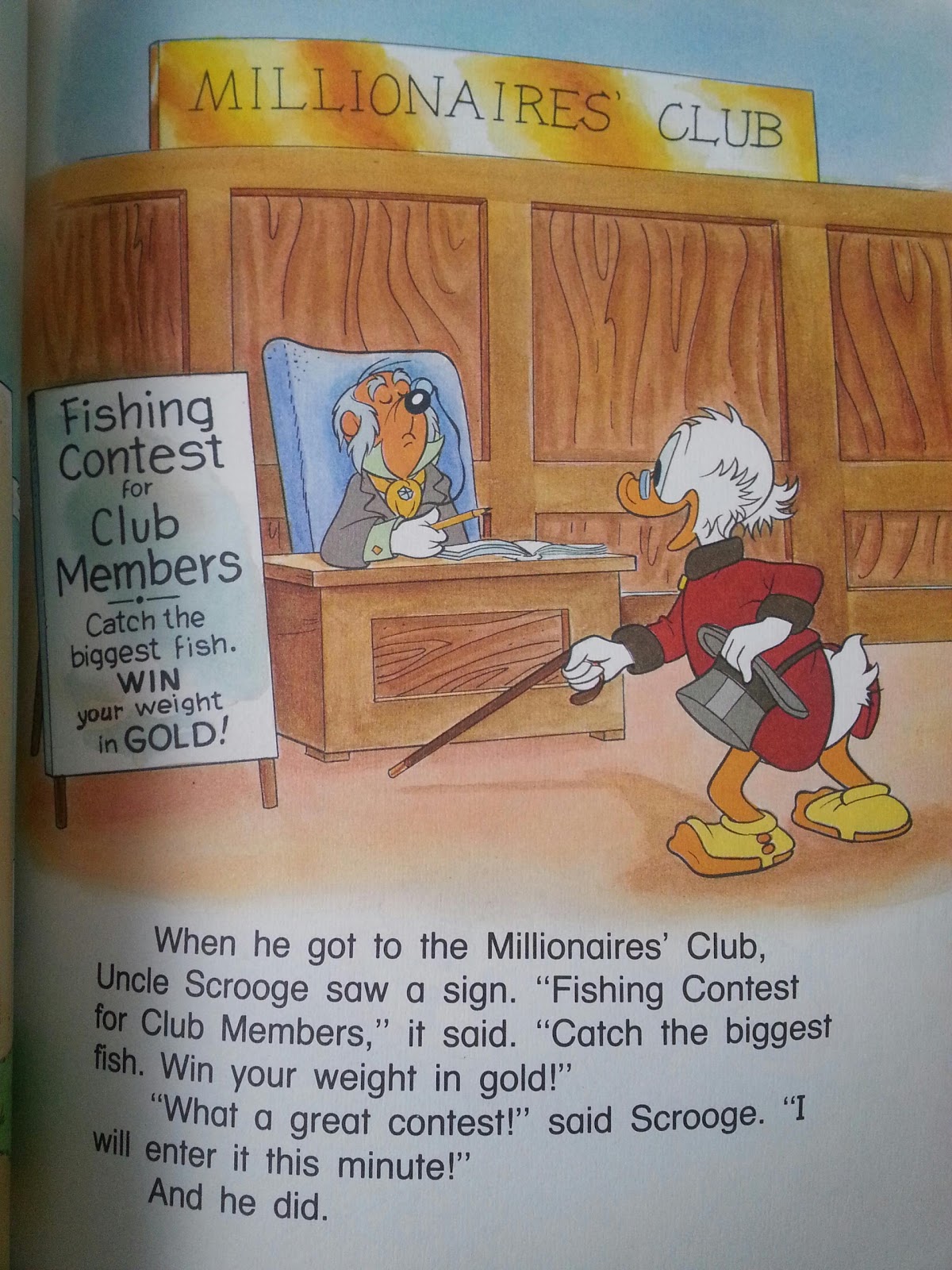
"Scrooge and The Magic Fish" was part of a series of children's books featuring Disney characters called Disney's Fun To Read Library, published by Bantam in 1986. The author and illustrator were not credited, but the art style is not unlike how the characters appeared in the Disney comics of the 1960s and 70s. Published just one year before the premiere of Ducktales, it offers an image of Scrooge that's a bit more complex than he would ever appear in other children's books, aside from adaptations of Mickey's Christmas Carol.

The book adapts the fable of "The Fisherman & His Wife" with Scrooge cast in the role of the fisherman. In the fable, a fisherman catches a fish that will grant a wish for whatever the fisherman desires in exchange for sparing its life. The fisherman agrees, but his greedy wife pressures him into constantly going back and forth to make more demands for a greater prize, each trip trying the fish's patience until he decides the fisherman was better off in the state he was before their encounter - with nothing.

The adaptation changes things considerably by playing off Scrooge's manic, dark side within the context of a simple fable - and he does have a dark side : his vanity, his greed, his insecurity, his bipolar tendencies (content, self-possessed, confident, resourceful one moment...frantic, hapless, paranoid, cynical and fickle the next) - all in a convincing way, along with the change of atmosphere; things literally get darker - storm clouds form, Scrooge's undeserved sense of entitlement makes him oblivious to the dangerous weather, the fish's slow burn... it all works.

Donald Duck appears in the story - he does play the role that the wife played in the fable, but he steps out of character to play the voice of reason and show that even he can be wise. Sometimes. Instead, all the conflict is really supplied by Scrooge, who sees his fortune as "half-empty" and is desperately trying to seize/exploit an opportunity that was only meant as a show of grattitude by a magic creature.

The story ends with the status quo restored: Scrooge is still a tightwad, but he appreciates his hard-earned fortune better than he ever did, as this tale seems to argue.. I really wish I knew who wrote this. There's not a single false note to be found. It wasn't Carl Barks, was it? Could this be a lost tale by The Duck Man?

Here's a hint about the book I'll review next time: scratch and sniff.

Saturday, July 27, 2013

Silver Dollars: Ducktales Anniversary, Part 5

For this installment,  I thought it would be fun to take a look at some of the original children's books that were created to capitalize on the success of the Ducktales TV series.  There are plenty of articles and discussions devoted to the comic books and the magazine, but this venue - prose fiction - has been left unchecked.

All of the books featured in the gallery below are presented in order by the year they were published - 1987, 1988 & 1990 - in groups of two, although there was a third title published in 1990, Ducktales: Journey To Magic Island, which I don't have, so there's no picture to offer...yet.

Some notes:

1987:
The Hunt For The Giant Pearl : has the best-looking cover of the lot. I think it was drawn by Daan Jippes, who drew many Donald Duck comics and  illustrated the covers for the Ducktales comic book when it was published by Gladstone Comics in the late-80s. The cover art is uncredited,  so that's my guess. A different artist (also unknown) worked on the interior art, which is not as lush as the cover. The real charm is the plot, which features Flintheart Glomgold teaming up with Magica De Spell for the first time, though it seems odd that Scrooge would fail to notice them together in an early scene (pictured), plus a neat gadget from Gyro Gearloose.

The Great Lost Treasuse Hunt:  is not credited to any author, but it appears to have been inspired by the 2-hour TV premiere, "Treasure of The Golden Suns". Mrs. Beakley did not accompany Scrooge and company on any treasure hunting expeditions afterwards, but the author assumed she would be and hazzarded a guess as to the direction of the series!

1988:
Webby Saves The Day :  is the book that most fans of the show might recall the most because it was promoted as a selection of "Disney's Wonderful World of Reading Book Club". This was a mail-order book club that often advertised in magazines - most of the books offered were adaptations of Disney films. WSTD offered an alternative take on the plot of "Treasure of The Golden Suns" , in which Donald Duck is not joining the Navy but "...away on a trip", there is no lost treasure, no wooden ships and crazed sea captain, just a retelling of how Mrs. Beakley & Webby met Scrooge and the nephews, and how the Beagle Boys tried & failed at robbing Scrooge in a home invasion. At this point, the book sounds a lot like the plot to "Donald Duck: Instant Millionaire" an older book with an attempted burglary  at Scrooge's mansion.

The Secret City Under The Sea:  is the first book to be credited to a writer and artist.Writer Paul S. Newman is often referred to as "King of The Comic Book Writers", simply for being very prolific - he wrote the original Turok comic book for Gold Key and a batch of Darkwing Duck comics for Marvel, as well as a lot of Disney comics. His approach to writting a Ducktales story shows a writer who's done his homework and is consistent with the tone of the show. Bill Langley's art captures the look of the show.

1990:
Down The Drain: 4 years later, the tone of the books changed, appealing to much younger readers. One thing all the books on this list have in common is this: the nephews are just along for the ride, Webby gets to be the hero. Justine Korman's story resembles many of the Webby-centric episodes of the show, which often involve her left to her own devices (and the assistance of some cutesy animal friends) to confront a challenge....not unlike most Disney movie heroines, really. In this case, she befriends two talking rats (which seems odd, since there always seemed to be unspoken rules regarding anthropomorphic "funny animals" interacting with "real" animals - I think Korman was inspired by Chip n' Dale's Rescue Rangers when she wrote those scenes). The book has the Beagle Boys adapt the urban legend about alligators-in-the-sewer for their latest crazy-gimmick crime wave. Willie Ito's artwork has fun with it, particularly the sewer scenes.

Scrooge McDuck's Birthday Surprise:  Cindy West has the good fortune of having Bill Langley illustrate her story - a Little Bear-esque romp in which Scrooge lets a series of vague messages lead him to a "surprise"...on his birthday. This book depicts Scrooge with a blue top hat, which has a glossy look to it. We get to see Gladstone Gander in his 2nd children's book appearance (more on that another time). This light tale may be a fitting finale;  it ends with a celebration - a wrap party! Few children's book series ever get to have a graceful finale these days. It's unlikely there'll be any more prose fiction based on this series. It will do just fine.