Showing posts with label Book Reviews. Show all posts

Thursday, May 20, 2021

How To Read Donald Duck: Imperialist Ideology In The Disney Comic by Ariel Dorfman and Armand Mattelart, Translated by David Kunzle

This is a review of the 4th Edition, published in 2018 by OR Books.

 How To Read Donald Duck is one of those books that seems ridiculous at first, but then offers a couple of convincing passages of rhetoric that make you say, "Maybe these guys are right about something...about what I have no idea.." 

    They like Jiminy Cricket; they really don't explain why this scene is included, unless it's implied and the implication went over my head; I prefer to think it's because they like Jiminy Cricket.

    They also like Moby Duck, although in this case, sampling from his comic book is actually clear..I used to have this comic; if you're actually appalled, send all your complaints to Mark Evanier; maybe he knows who wrote it. Including Moby Duck in a treatise on Disney is probably the most flattering thing to say about this obscure character, even if it's meant to be part of something negative.

 The book, first published in 1971, is built around a false premise: they want to regard Disney comic books with contempt because the Disney brand itself is associated with heavy merchandising, so any entertainment offered to foreign countries by the company must be a propaganda tool, right? No, not when the "evidence" offered is from the peripheral corners of Disney company; essentially, they point out what they believe is a poor effort at convincing the audience they could achieving anything by following the comics as a model of a domesticated, American-flavored utopia, with a sexually marginalized consumer culture and capitalist economy; the main text is under 120 pages.

         "Sufferin' Suffrenture!"

 What makes the book interesting to read is when their observations are genuinely interesting - where it becomes clear that they have read the comics and observed recurring themes in the stories that hint that they're onto something, but it veers more toward profiles of the various Disney comic book protagonists and a tangent from their big picture thesis, so they don't develop it any further; it wouldn't draw attention like associations with Colonialism, Freudian stereotypes, cultural/ethnic caricatures or abnormalities with anthropological animals; the passages dwelling on those subjects are flooded with tangled jargon - they're the most boring parts of the book.

 The most intriguing part of the book is Chapter 5: "The Ideas Machine". Dorfman & Mattelart are still trying to suggest this material is flawed propaganda, so they argue in this chapter that Donald, Mickey & Scrooge are terrible as aspirational characters because they each live a charmed existence with contradictory drawbacks: they argue Mickey doesn't suffer bad karma because he uses his intelligence to solve mysteries and outwit criminals; his altruism is rewarded with a nice life, though he has to live like a perfect Boy Scout and his life is very bland; Scrooge is wealthy and poor at the same time: he's wealthy, but he is stuck - he enjoys his fortune the way a hoarder enjoys their collections of junk, but it just lays there in his money bin, yet because his hoard has value, it is vulnerable to theft, with the hint that the loss of his fortune is the death of him; his money is his life, but he lives by keeping as much of it as possible. They conclude he's a tragic figure, which ironically makes him sympathetic, because he forever remains a rich tycoon.

 Donald Duck - or, to be specific,  the comic book Donald, who is a more deeper character than the cartoon Donald, yet was so sharply modified by cartoonist Carl Barks in his stories, he became complex enough to have subsumed the animated cartoon version of Donald and is essentially considered the same character appearing in all media - from their socioeconomic perspective, is the strangest character of all. At one point in this chapter, they conclude that Donald pretends to work. In all of his stories, Donald is never in danger of losing parental guardianship of his nephews, Huey, Dewey & Louie; he is never in danger of losing his home or car; he is almost always unemployed, in a sitcom fantasy world where jobs are always available and never scarce. He is totally incompetent, often fired for his bungling, but finds another job anyway. His usual motivation for working is he wants to earn money to buy gifts for his girlfriend, Daisy, or toys for the nephews, or complete down payments on luxury items for himself, like a TV set. Many of the jobs he works in are at factories, which have become a scarce source of employment in the United States with each decade, as manufacturers found outsourcing from other countries a cheaper option. When Donald is depicted as being particularly good at a job, or accomplishing tasks all too easily without going through a daily grind, it's argued that he's trying not to be bored; his efforts at entertaining himself lead to making greater mistakes resulting in his termination. If he's successful at a job, like, for example, a janitor or museum guard, this is usually established at the beginning of a longer adventure tale that begins with him quitting this job so that he can take off on some far-flung quest. This behavior is defined in the book as freedom from labor; Donald only works when he's bored, is useless at a job that requires focus and attention because of his incompetence, but quits any job he's successful at because he's bored by the daily grind - he hates it when he succeeds at a job, because it will be dull, but would be awful at a job that demands him to be more active and lacks initiative to break from this. It's possible that this might be why the Disney comics from Europe had long established that Donald is subletting his home from Scrooge, who is presented as the true owner of the property, and, most-likely, the one who pays Donald's Bill's and makes sure his nephews are not living in poverty. So, in Italian comics in particular, there exists dialogue where Scrooge gets away with regarding Donald as an irresponsible parasite. In American comic book reprints of those original stories, this behavior always seems out of character for Scrooge, but is understandable when this overseas perspective of Donald & Scrooge's personalities is explained.

  Donald's cousin, Gladstone Gander, is considered a more aspirational figure than Donald, because his good luck allows instant success with no effort or gratification necessary, but there is no discernible career path for the reader to follow if they want to have a life like Gladstone, so he exists to make Donald look more sympathetic, because it's more possible to aspire to be like Donald and follow a path, even though it's been concluded that Donald is terrible at the follow-through.

 They postulate the only time Donald appears to truly be working are when he goes on adventures with his nephews and Uncle Scrooge, or when his sitcom life depicts him going to outrageous lengths to achieve mundane goals, like obtain a signature from an authority figure, feuding with his neighbor or nephews, or the act of falling in and out of a job itself. This is the first time I've heard of the term suffrenture - suffering coated with adventure. He goes through conflicts that are not exciting at heart, but have the capacity to be entertaining - the realm of freedom vs. the realm of necessity. When Hercules was tasked of cleaning the Augean stables of massive piles of horsepoop, this was not depicted as an ordinary farm chore, but one of The Twelve Labors, as important as chopping the heads off the giant Hydra or capturing Hades' dog, Cerberus.

So, that's the only thing I enjoyed about the book - one chapter, in which the authors were paying attention to what they read, but in support of their contempt. The rest of this book was a slog - a suffrenture that argues the Disney Company is doing a terrible job at manufacturing subliminal capitalist propaganda; you can read Donald, Mickey and Scrooge stories, but they're not helping you learn to live like them...we don't learn how to live right from them...and in that sense, those guys are right...? 

 It's not as though this book is the definitive guide to Disney Comics, anyway..there's still plenty of unanswered questions..


Monday, May 20, 2019

Doctor Who: Scratchman by Tom Baker (and James Goss)


I first heard of Doctor Who Meets Scratchman in 2008 - when the revival of the BBC TV series was truly at the peak of its trendiness and David Tennant was a few months away from passing the key to the Tardis over to Matt Smith. The show was so popular that there was talk of doing a spin-off movie, though whether it would star Tennant, Smith or a stunt-casted Robert Downey Jr or Johnny Depp was up in the air...well, that's what interested the people at Doctor Who Magazine, because they knew attempts at a film featuring the cast of the TV series had been tried before..

In the 1960's, there were 2 Doctor Who movies starring Peter Cushing as "Dr. Who", but he was playing a different version of the First Doctor, played by William Hartnell on television. In the 1970's, Tom Baker had become the 4th actor to play the Doctor on television and fancied starring in a spin-off film that would've starred himself and TV co-stars Elisabeth Sladen & Ian Marter, who played Sarah Jane Smith & Harry Sullivan, respectively.

This is what the lineup looked like:
    They liked working together. 

Baker collaborated with Marter on a film script that would've been in the style of the stories told at the time, which resembled pastiches of British gothic horror movies, usually the ones featuring Christopher Lee and Peter Cushing, but also Roger Corman movies featuring Vincent Price, Basil Rathbone & Peter Lorre. I personally prefer the era where Baker is hanging out with Mary Tamm or his future ex-wife Lalla Ward offering gummy bears to megalomaniacs while tinkering with upgrades for his robot dog/valet, K9.


K9, meet K9...Now THAT'S a crossover!

 That being said, there are a lot of great moments featuring this team and the banter between them sparkles in ways that make other Tardis teams look like an assembly of actors.

The film's plot was the 4th Doctor vs The Devil, possibly the biggest representative of evil the character could've faced. Longtime foes the Cybermen and the Daleks would've served as guest-villains. The Devil, going under the name "Scratchman" stages elaborate scenarios to get the Doctor's attention, including an army of scarecrows terrorizing a village...

           Cool, but not quite what we got...

   Uh..kinda yes and no..happens later, but this is going to be a spoiler-free review, because it's good enough to recommend.   

That's more like it! 

Those scarecrows are the main original monsters in this adventure. Scratchman would've been played by Vincent Price:

Artist's conception. Of course 

The final showdown between Scratchman, the Doctor, after many twists and turns, would've taken place inside a giant pinball machine in place of a labyrinth:

Certainly larger than that, but you get the idea.

Having outwitted Scratchman, the Doctor and his friends return to the Tardis and party down to the tune of "Yes, We Have No Bananas."

I'm reminded of Marvin Suggs & His All-Food Glee Club rendition of that old chestnut..

And that was all that was known of the film, according to the only surviving copy of the 1st draft of the screenplay, found among papers belonging to departed 1980's Doctor Who producer John Nathan-Turner. Proper financing for the film couldn't be found, plus the effort seemed awfully humble in the wake of Star Wars and Star Trek movies either in-development or already released. It was condemned to "development hell" and talk of even adapting the script into a novelization at least began when the scripts authored by Douglas Adams for "Shada", "The Pirate Planet" and "Doctor Who And The Krikkitmen" were being novelised. Up until then, fans had to settle for a vaguely detailed synopsis with a speculative mock-up of a movie "poster" published the TV series official tie-in magazine to indulge our imagination...


Baker collaborated with writer James Goss on a reimagined version of this story, with the end result being a novel written & published in 2019, so it will have a cameo by Doctors 10, 11, 12 & 13, plus a feeling of a "last hurrah" proper for Tom Baker in his own words, particularly as he approaches his ninth decade. Goss cleans up the narrative to feel less cinematic and more like an extra-long adventure from the original series, so it's familiarity may make it seem more cozy than groundbreaking; but that's usually the highest compliment a tie-in novel can recieve. Considering how there aren't too many novels featuring the 4th Doctor because writers found him tricky to convincingly transition to plain prose, the fact that his portrayer on television succeeds while the seasoned journeymen didn't makes this adventure worth your time.

One thing that bothered me: it appears they couldn't get permission to use the Daleks as they appeared in the screenplay, so they were substituted with giant Chess pieces...it's okay, but they're no Daleks.

Not quite as it appears in the book, yet it has the right ring to it..I actually think Goss & Baker should've realized the Chess pieces this way, rather than as golf carts. Spoilers.

Friday, October 19, 2018

Only To Sleep by Lawrence Osborne

          Way out west, there was this fella,
         this fella that I want to tell you about,
          fella by the name of Philip Marlowe.
          At least that's the handle his beloved,
          yet often sozzled creator gave him.
          But he never had much use for it
          himself.
          This Marlowe, he often called himself
          a "Shamus", with emphasis on
          "SHA" when pronounced, like
          "Sha-na-na" and not "Shay". Now,
          Shamus, that's a name no one
          would self-apply where I come
          from. But then there was a lot
          about this gumshoe that didn't
          make a whole lot of sense to me.
          And a lot about where he lived,
          likewise. But, then again, maybe
          that's why I found Marlowe and the
          place he lived in so durn
          interesting.
          Now this here story I'm blogging
          about took place in the late-80's,
          just about the time of Madonna
          and Max Headroom and cartoons
          talking mermaids and dogs talking
          like Burt Reynolds and just before
          Michael Keaton put on a pair of
          Nike boots and dressed up as
          Batman. 1988. I only mention it
          'cause sometimes there's a man,
          I won't say a hero, 'cause what's
          a hero? But sometimes there's a
          man, and I'm talking about this
          shamus here, sometimes there's
          a man - well, he's NOT the man for
          his time and place. He DOESN'T fit
          right in there, he's an anachronism,
          and that's Philip Marlowe, in Los
          Angeles. And even if he's not a very
          perceptive detective, and Marlowe
          was most certainly NOT that, quite
          possibly the least-perceptive player
          in his chronicles, which would place
          him high in the running for the most
          clueless, yet highly-respected sleuth
          in detective fiction worldwide...But
          sometimes there's a detective...
          sometimes there's a detective...
          Ah, I lost my train of thought, here.
          But...ah, hell. He's the only one who
          cares. I done introduced him enough.

         
Writers will do a thing sometimes to amuse themselves with the manuscript. They'll name-drop an actor who could be their choice for playing the character in their book for a possible film/television adaptation. With Only To Sleep, Lawrence Osborne drops Beau Bridges in there, in passing. Beau Bridges as Philip Marlowe? Or in this case, a 72 year-old Philip Marlowe. Possible. But frankly, nowadays the actor playing Philip Marlowe in a new movie with the surname of "Bridges" is likely to be Beau's younger brother, Jeff. The Dude. Playing Jeffrey Lebowski has become Jeff Bridges performance by default...I don't know if his own personality became subsumed by the character, or if it crystallized him, made him identifiable in a way that he wasn't in roles played prior to The Big Lebowski, which I always thought was the Coen brothers' answer to Pulp Fiction and is arguably more-popular than the latter nowadays...or it just seems so, since you can find Lebowski re-released in theaters every summer and is on basic cable as often as Goodfellas...

             Ah, I'm going off on a tangent..

No, back to Marlowe. He's 72 in this book, retired and walking around with a swordcane...'cause that's a cool "toy" on every old man's want-list. He feels like he's marking time, but young, 38 years-old Marlowe always talked like that in the old books..I can't remember the blogger who wrote it, but he observed that Marlowe always acts like he's wondering why he's alive, and that attitude is in this new book, too, so it feels authentic.

This is the fourth Marlowe novel authorized by the estate of Raymond Chandler. The first three tried coasting on scraps - Poodle Springs was built off 3 brief sample chapters Chandler probably typed up to amuse himself (Marlowe married to Linda Loring? Heh heh heh), Perchance To Dream was Robert B. Parker's sequel to The Big Sleep, which only felt an attempt at identifying Marlowe with his own private eye character, Spenser, followed years later with Benjamin Black's effort The Black-Eyed Blonde, which proved you could do pastiches of Marlowe in perpetuity, but would you really want to read them if it doesn't feel like Marlowe was brought back to life? That's the appeal of the Chandler books. Marlowe may never realize that he's the only character in his stories that's not hip to what's happening, but he's the only character who cares, and the real highlight of the books of finding out what he cares about in each tale that makes him push on in these quests. In The Big Sleep, he felt bad about invalid General Sternwood saddled with two dirty daughters. What's he looking for to care about in Only To Sleep? Osborne decides it's the father of the man whose identity was stolen by Donald Zinn - a con artist who faked his death and is living a new life in Mexico with his younger wife. Marlowe takes a fancy to this femme fatale, but like the Marlowe of old, he resists her comely charms while revealing that he's still tempted as he was in the old days, even though he no longer looks like a matinee idol, if that's how he ever ever thought he looked like.

Zinn is clearly a dark mirror-image of Marlowe, though I can imagine John Slattery playing him in the movie, with Ana de Armas as Delores Araya, Zinn's "widow"/partner-in-crime/able Grable/Marlowe's femme fatale. He's living the life Marlowe toyed with having accepted Linda Loring's impulsive marriage proposal in Playback and tried out in Poodle Springs before Osborne's revelation in Only To Sleep:

"You know, I was married once, but the condition doesn't agree with me. It makes me unstable."

Rather eloquently put, that. There are a lot of passages in the book that give it a convincing texture, even though itdoesn't make much of the fact that it's set in the 80's. It feels it could be set in any decade pre-internet and the results are the same. The window-dressing was never the appeal of the Marlowe books. You read Marlowe for Marlowe. And this feels like Marlowe. Ironic that he's now the same age as Jane Marple or Hercule Poirot, given how Chandler thought little of Agatha Christie's work, but the private eye genre can be just as unreal and far-fetched. Read whatever you like.

Osborne's timeline suggests Marlowe would've turned 100 in 2015, yet because he can exist in that charmed state of suspended animation that keeps fictional characters from aging further, he could still appear again, this time with a swordcane in hand for his 2nd life, pondering the ephemerality of life and the persistence of yearning...he's a Miyazaki character, now.

             
              Well, you know...sometimes
               you eat the bear, and
              sometimes, you know...
             
              The shamus abides.

              I don't know about you, but
              I take comfort in that. It's good
              knowing he's out there,
              the shamus, taking her easy
              for all us readers. Shoosh,
              I hope he keeps on going
              into the next millenia. Well,
              that about does her. Wraps
              her all up. Things seem to
              have worked out pretty good
              for the shamus and Delores.
              And it was a pretty good story,
              don't you think? Made me
              laugh to beat the band...
              parts anyway. I didn't like
              seeing Delores go. But then
              I happen to know..there's a
              little Marlowe on the way. That
              might just absolute horseshit
              on my part, but I believe that's
              the way the whole darned human
              comedy keeps perpetuating
              itself down through the
              generations. Westward the
              Studebakers, across the sands
              of time until we - oh, look at
              me. I'm rambling again. Well,
              I hope you folks enjoyed
              yourselves. Catch you later on
              down the social media trail.
              Say, friend, you got any more
              of that good non-alcoholic
              margaritas? Margarita Hayworth?..

Sunday, August 12, 2018

Doctor Who: The Stone Rose by Jacqueline Rayner

Genies are tricksters. Be careful what you wish for. In some tales, the actual wording of the wish you make begats unforeseen consequences. You wish you were rich...and the bill collectors show up. You wish you had a new car...and it's a car belonging to some wealthy drug lord...You wish you were famous...and it turns out you are that wealthy drug lord, pursued by bounty hunters...in that new sportscar you wished for. Nice.
And that's three wishes, already. Some tales hint about wishing for more wishes...others say ixnay on the 'wishing for more wishes'. Next Master, please.
And there's the character of the Djinn, or Genie. They rarely ever look like Robin Williams or Barbara Eden in these stories. The genie of 1001 Arabian Knights has more in common with Jafar when he became a genie in Disney's Aladdin. The business of Tony Nelson marrying 'Jeannie' was inspired by Bewitched, which was inspired by the movies I Married A Witch and Bell,Book and Candle...which might be inspired by the farcical "romance" scenes with Titania the Fairy Queen & Bottom in Shakespeare's A Midsummer Night's Dream...that theory is entirely mine..though I don't think it's an original conclusion; I haven't checked if anyone else saw that.
There is a genie of sorts in Doctor Who: The Stone Rose, but the selling point of the novel was the 10th Doctor & Rose investigating the origin of a stone statue dating back to ancient Rome resembling Rose Tyler residing in the British Museum in London. Yes, this predates the episode revealing that the 11th Doctor's sidekick, Rory Williams, was working at the same museum as a security guard, so there's some wibbly-wobbly overlap for a potential future "Past Doctor Who Adventure" for Gareth Roberts or James Goss to type up if they want...they'll just need to have an icebag ready to deal with resolving continuity headaches. I'm not going to do this, so I can keep mulling over it.
The genie in Stone Rose is a Genetically Engineered Neural Imagination Engine. Described as a small, scaly creature, a cross between a baby dragon and a duck-billed platypus.
And...this "Genie" talks like Flintstones character The Great Gazoo. The best stuff in Stone Rose is the stuff with this G.E.N.I.E., but he appears in the last quarter of the book, so it's all plot denouement rather than plot & character  development; it becomes a Saturday Morning Doctor Who...with animation by Filmation, likely, but the concept of this magical creature, particularly the dragon-like description and Gazoo-esque personality, stayed in my brain years after reading the book.
It reminded me of other characters from other places. The best example is the wish-granting, genetically-engineered lab experiment resembling a dragon that appeared in an issue of World's Finest, featuring Superman & Batman, in a story written by Dennis O'Neil. Doesn't that sound like a likely inspiration? There are plenty of fantasy stories about a stopwatch that stops time, for example. Stories about magic dragons granting wishes, in summantion, sound more frequent than one would think. While preparing this post, I remembered Figment, the magic dragon from Epcot Center at Walt Disney World who had his own comic book series from Marvel Comics a few years ago. There are also Pocket Dragons, Smurf-like plastic figurines of cutsey baby dragons that even had their own cartoon show at one point. I'm absolutely convinced that G.E.N.I.E could've been based on one or any of these things.
So..in time for the 50th Anniversary of Doctor Who, original novels like The Stone Rose were reprinted..in this case, because it counted as an historical adventure  (everyone seems to just remember the David Tennant Doctor facing a lion in the arena, go figure). And..according to Wikipedia, it was the best-selling of the Doctor Who novels from the current series, so that's something, although maybe those Douglas Adams-branded novelizations of Adams' Who scripts might've bumped that down a few notches by now.
So the newer edition of Stone Rose came with an introduction by the author, Jacqueline Rayner. Would she bring up the G.E.N.I.E character? Yeah, she did. Should I buy this book? Yeah, I did. Did she confirm all that you thought inspired the character? No, she didn't - she claimed she was inspired by the severed monkey's paw from "The Monkey's Paw", which, to my knowledge, does not feature any dragon-platypus hybrids. Maybe she gave that answer because the plot mechanics in that last quarter do echo the story, but the reference that inspired the visual of the G.E.N.I.E is not there, so that may be her way of dodging any concern about copyrights and trademarks.
It's like this: I think I solved a puzzle, but the answer key provided to check is some kind of nonsense, so I'm just left with a gathering of stray observations that fit into something that made the book more-appealing past it's sell-by date, but will just stay scattered in the air...be careful what you wish for..

Saturday, March 24, 2018

"Totally Awesome: The Greatest Cartoons of The Eighties" by Andrew Farago

Let's get to that list, shall we?

In the order by which they appear in the book:

1. The Smurfs

Each respective series on the list has a chapter devoted to a condensed history of its production, with quotes offering insights on the development of the show. Interestingly, the spotlight shines on one person in particular, who is strongly suggested to be the reason for the series success...and in some cases, it's someone I didn't know much about before. Regarding Smurfs, it's Gerald Baldwin, who shepherded the first four seasons of the show. This was Hanna-Barbera's first major hit in over a decade; much of the 70's was wasted capitalising/cannibalizing the initial success of Scooby-Doo, Where Are You? (even Superfriends had it's genesis as a Scooby-Doo knockoff) or dull, gimmick-riddled new cartoons featuring faithful standbys Fred Flintstone or Yogi Bear. I liked learning that The Snorks was a dumping ground for rejected Smurfs story ideas, and that Baldwin thought The Smurfs and The Magic Flute was "crappy". To be fair, I thought the animation in Magic Flute was about as good as the TV series animation ever was, but the pacing of the story and the voices were poor.

2. Spider-Man and His Amazing Friends

..in which Don Glut bemoans his lot, forever associated with the late Dennis Marks' apocryphal, yet charming take on Spider-Man that was inspired by the Bob Hope-Bing Crosby-Dorothy Lamour "Road to..." movies, in which Spidey had adventures and told/traded jokes while hanging out with Iceman & Firestar. Glut HATED Ms. Lion, Aunt May's pet dog, created by Marks as a mascot/pet for the series, and would insist on inserting scenes with her in scripts that Glut intentionally wrote her out of. Meanwhile, the rest of us fans of the series in the U.S.  wonder if Disney will ever wake up and release the series on Region 1 DVD.

3. He-Man and The Masters of The Universe/She-Ra: Princess of Power

Lou Scheimer hit the jackpot, here. It just so happens a generation of incredibly talented artists and writers cut their teeth working for Filmation during this time - even taking advantage of a brief strike at the Disney studio, which resulted in some top talent in need of work. Both of these shows were better than they were likely conceived to be, with the push to be toyetic.

4. Inspector Gadget

Less than a handful of Bruno Bianchi's concept/development sketches of Inspector Gadget are reprinted in the book...Bianchi's style reminds me of Sergio Aragones - that got me imagining a great Inspector Gadget comic book that seems obvious, but we have yet to see, drawn by Sergio Aragones. That would be cool.

I recall the idea of Gadget's extendable arms and legs was based on Dynomutt, because Andy Heyward had worked on both shows.

5. The Transformers

As with He-Man, She-Ra and perhaps G.I. Joe, The Transformers  has been the subject of coffee table books of its own, so the ground covered here has been well-tread, but inserted for posterity. The weakness of the book becomes more obvious in these sections, but I have a nice anecdote of my own to share: years ago, on the Comic Book Resources forums, series writer Buzz Dixon had responded to my question about the trailer that Optimus Prime is always shown towing when he's in the form of a truck..Where does that trailer come from? It's clearly a separate component/accessory, not part of Optimus Prime in his robot form. And yet, whenever/wherever he transformed into a truck, the trailer slides into place! Dixon confessed that none of the people could figure out an explanation for what that trailer's deal was(!)...and just let it go as something they weren't going to put much emphasis on.

6. G.I. Joe: A Real American Hero

You do get a sense that the people who enjoyed working on these shows the most wanted the audience to believe that they believed in the series' concept. I'm tempted to look up the earliest, "improvised" episodes of G.I. Joe, then stare-and-compare with later "researched" episodes, since the animation for all the Sunbow-produced shows was rarely particularly good..and at the end of the day, this show was always about a bunch of guys dressed as The Village People vs. a bunch of guys dressed like the bad guys from Spaceballs.

7. Jem and The Holograms

This is a concept that probably would've been more popular than it was if the animation and stories matched the energy and pace of the title sequence. I don't know...the theme song/sequence was catchy enough to draw you in (though I wouldn't say that out loud) but the "Afterschool Special"/soap opera-feel to the stories was too earnest, imo. It should've been more like Josie and The Pussycats in story-style...that's probably the way it would go if there was ever a reboot.

Btw, Rich Morris did a truly truly outrageous unauthorized Jem/Doctor Who crossover webcomic years ago that's archived on his Shipsinker website, which established that Stormer and Eric Raymond were errant Time Lords from Gallifrey...believe that, true believer..believe that.

8. Thundercats

I think YouTube still has this audacious fan-made trailer for a live-action Thundercats film, culling footage from Troy, The Chronicles of Riddick, Stargate, and I don't recall offhand what else, then digitally coloring Brad Pitt and Vin Diesel to resemble Lion-O and Panthro. Vin Diesel is a movie producer, YouTuber; dare Vin Diesel to make a live-action Thundercats movie and he'll do it!

9. Muppet Babies

This is one of those shows where you'll have to trust me was actually good; it has Jim Henson's fingerprints on it - the Henson heirs are trying to "Walt Disney's"-brand name recognition on new stuff that didn't even exist as incoherent scribbles in any of Jim's notebooks, but Muppet Babies has his stamp proper...this, Fraggle Rock and the first live-action film with the Ninja Turtles were the last truly commercially successful projects completed during his lifetime.

..and I wish they revived Kermit the Frog P.I. - I have vague memories of seeing that cartoon and that was the only part of Little Muppet Monsters that worked for me. They should try it again...I think the Dog City TV series came from that, somewhat...but no...let's do this again with Kermit and Fozzie proper this time.

10. The Real Ghostbusters

The irony for artists and writers working on animated cartoons airing in "Seasons" is that production on these series made the work itself seasonal; they hopscotched from one animation studio to another. Any show made during this decade will likely have the same five or ten guys on average with their names on the credits. To read Tom Sito gently slam Filmation's Ghostbusters while praising DIC's The Real Ghostbusters is pretty funny, since he appears in interviews and commentary on the DVD box set of the Filmation show. The franchise is such a fallow state since the Paul Feig reboot blew that I've half-jokingly suggested adapting the 1980's animated incarnation with Jake, Eddie and Tracy the Ape into live-action. The stories may just be recycling He-Man tropes with a lighter tone, but the animation and character designs and more attractive than the Real version, which is pretty creaky-looking.

11. The Disney Afternoon (this is a cheat, as the author is actually talking about Disney's Adventures of The Gummi Bears, Ducktales and Chip 'n' Dale Rescue Rangers )

..and "The Disney Afternoon" didn't officially premiere until September of 1990, unless people want to count it as part of the 80's, but 1990 felt like a new start at the time to me...aside from fashion designers attaching neon colors on clothing...

The Disney shows from this decade get short-changed, imo, as there's "Before Disney Television Animation" and "After Disney Television Animation". This was a game-changer that deserves a book of it's own. The chapter was an interesting introduction to Tom Ruzicka, whom I hadn't read much about before, or his and Fred Wolf's critical contribution to the early days, when Gummi Bears was actually going to tie-in with a line of candy (how come Haribo makes "Gummy Smurfs" but no "Gummy Gummi Bears"?) and that The Wuzzles and Fluppy Dogs were specifically designed to sell toys, whereas Ducktales was actually created to capitalize on the success of Gummi Bears moving away from its toyetic origins and becoming more story-based (the Gummis themselves were going to be named after candy flavors...is that why Gruffi Gummi is sometimes depicted in red on licensing instead of brown? What would've been his name: "Redd Gummi"?).

12. Teenage Mutant Ninja Turtles

The 1980's cartoon incarnation is still the best. All the credit really goes to three people: Fred Wolf (for selling the show), Dave Wise (for giving us an entertaining show) and Chuck Lorre (for giving us that iconic theme song - I liked learning that it was actually Chuck's voice that's shouting "We're really hip!"/"Hey! Get a Grip!"/"He's a radical rat!"/"Gimmee a break!" - I remember thinking that was Rob Paulsen, the voice of Raphael, because that's who it sounded like).

13. Garfield and Friends

On his website, Mark Evanier opts for writing about celebrities/writers/artists he knows and politicians he dislikes rather than stuff he's actually worked on. Oh, and dispensing career advice for would-be freelance writers, I guess, though it comes off more interesting than useful. And obits for people he knew...and people who he never knew (to which he writes, "I don't have any stories about Austin Tasseltyne because I never met him or worked with him, but people liked him and his movies/TV shows/apple pies were quite popular, so he had that goimg for him."). Rarely does he divuge actual stories about his work...or at least without filing the names off beforehand. So it was nice to get him to talk of his time writing Garfield and Friends episodes, because he doesn't talk shop much on his blog about his work, which is unfortunate, because I think it's better-produced than the more-acclaimed TV specials that preceded it. Garfield reached the zenith of his popularity around this point. Ironically, the comic strip is more popular without him, assuming you haven't checked out Garfield Minus Garfield.

14. Mighty Mouse (actually, this was billed as Mighty Mouse: The New Adventures, but that was the author's choice on how to identify it in the chapter heading).

With anything from Ralph Bakshi and John Kricfalusi...the superb character design and background stylings will always be marred by the inability to realize that neither can write anything worth a damn. I was most disappointed in this section, because it was fuzzy on details as to how Doug Moench contributed to the writing of the show...I have to hazard a guess that it was his job to transcribe a presentable script from the final layouts that would be passed along to other production/post-production staff - voiceover/music/editing/sound/overseas animators. Most of the people who worked on that show have had long careers since then, but Bakshi and Kricfalusi are infamous for downplaying the craft of writing as an art form that has it's own technique and discipline. As a result, everything they've done has always come off amateurish and slapdash, storywise, because they focus everything on the drawings.

So...I enjoyed this book, it's good, but not great. Something's missing. The presentation is attractive - I like how there's samples of production notes and artwork from several series reproduced and attached ontop of pages, like they've been paper-clipped, giving the book a feel like you're reading a dossier with supplementary information thst could literally spill out. However, with a book like this, you'd think the author would present a stronger defense/commentary in his text for why these shows deserve to be the greatest cartoons of that decade. The title doesn't even specify that it's necessarily just cartoons on television, but could imply animated feature films, of which I could think of six that could bulk up that list to 20:

15) The Secret of Nimh
16) The Castle of Cagliostro
17) The Great Mouse Detective
18) Transformers: The Movie (although this could be lumped in with the TV series, ad it is discussed in the chapter devoted to that show, but it's strong enough to be a separate contender)
19) Who Framed Roger Rabbit?
20) The Little Mermaid

Yeah! And I didn't even get to include animated short films, of which I would suggest Night of The Living Duck and A Grand Day Out as worthy of inclusion. That would make 22.

And then there's a curious happening with (13) and (14) on the book's list: he switches the order by which the series debuted. Up until then, the list follows a timeline; Mighty Mouse: The New Adventures was old news when Garfield and Friends debuted the following year. Maybe that's a reflection on how the cartoons debutingthe following take their aesthetic cues from Mighty, particularly the Nickelodeon cartoons. That's left for us to infer. In fact, the author leaves it to the people who worked on each show to offer their conclusion as to why the respective series is considered great; it's like, "Hey! Here's my list. That's it. 'Nuff said." At a price of 50 bucks, I wouldn't mind more insight on what made these 14 cartoon shows better than other programs offered. There's no sidebars devoted to "Memorable Episodes" or "Honorable Mentions: Good Cartoons That Didn't Make The List". Those would've been cool things to add. There's unanswered questions..why isn't Fraggle Rock in there? Voltron? A Pup Named Scooby-Doo (the template for every new Scooby-Doo cartoon made since the 1990's). How about the 80's revival of The Jetsons? Or Heathcliff and The Catillac Cats? Or Thundarr (I don't care much for that one; the talent behind that series was more interesting than what they produced, but it has a loyal following). I might've been incorrect about the last two, but if I had seriously disagreed with any of the choices in that book - and I didn't, for the record; I agree with all the choices in there - then I would've thought this was just cobbled together by someone who had taken a light survey on social media and his content is grounded on the results of that. The text is just perfunctory and the only fun in reading it is the quotes from the people who worked on each show.

Curious thing I found while preparing this post: I found an alternate cover photo of the book - most likely a mockup for early solicitation purposes; there's a disclaimer on it saying it's not the final image...this cover has images of Voltron and the guys from muh-muh-muh M.A.S.K. on it. Perhaps they were just thrown in there to create suspense and surprise when the final cover was revealed, but I can't help feel we might have some alternate chapters that didn't make final cut...or it was just a ruse to prevent spoilers from leaking.

I'm trying to imagine how a follow-up book devoted to the 1990's would look..

Darkwing Duck
Ren and Stimpy
Beavis and Butthead
Gargoyles
Batman: The Animated Series
Animaniacs
Pinky and The Brain
Freakazoid!
Rocko's Modern Life
Rugrats
Daria
Dexter's Laboratory
The Powerpuff Girls
Johnny Bravo
The Simpsons

See that? That's pretty close..some of those choices I don't even care for, but I don't doubt the authenticity of their being on that list. He should totally do it...and hopefully add some flavor to his rhetoric along with it this time.

Monday, November 14, 2016

"The Caped Crusade: Batman and The Rise of Nerd Culture" by Glen Weldon

That is not the actual cover to Glen Weldon's Batman book. In my humble opinion, I fixed it. I made it into a cover image I wanted to see, just like when I fixed the cover to Michael Moorcock's rubbish Doctor Who novel into something I might keep on my shelf (but I didn't). Who are all those guys cosplaying as Batman? I don't know them. They're not Batman. The new cover - that depicts the Batman.

That's really the point of Weldon's book. The lean page-count is due to the lack of biographical material; the real focus is on the different incarnations of Batman thru the decades, from dark to light to dark to light to dark again snd so on. He's a resilient, nonchalant character - adept at mystery, sci-fi and fantasy stories with a simple turn of the screw. I don't think he really cracks the code as to why that is so, but he's more interested on how audience opinion can influence the lifespan of each incarnation anyway. It's this school of thought where Batman is an idea that exists within the public conciousness..as if he's bigger than comics or films or videogames...Weldon doesn't say it, but the character is recognized the same way globally as Mickey Mouse, James Bond, Sherlock Holmes, Superman, Elvis, Marilyn Monroe and Michael Jackson. He's joined that club. A lot of people don't read the comics, but they are cognizant of the existence of a character named Batman.

It's what Batman is that has the nerds debating about it, and Weldon doesn't quite ridicule those arguments, but it's hinted as very closed-minded thinking. The best depiction of a fully-realized Batman, at his most basic, is the Batman of Batman: The Animated Series. After that, you're probably just going for extremes for the sake telling new stories.

The downside to this book is that it's nothing you wouldn't learn from reading a Wikipedia article. Without biographical material to gain insight into why people who worked on Batman approached the character the way they did, it's very, "...during this run, this guy wrote Batman like this.." And another thing...I seriously doubt anyone enjoys being called a nerd. The bozos selling t-shirts and apparel in an attempt to brand "Geek" "Nerd" and "Spaz" wouldn't be caught dead feigning interest in this stuff if they couldn't make a buck. I don't buy it. It's a slam for knowing anything.

And yet, the fact that people know Batman is what's kept him from stagnating like Superman, Bond and the Mouse. Alan Moore put it best when he described Batman as a character created to appeal to children in 1939 who were reading Superman comics...Batman's longevity is astounding if you consider that he's past his "Sell-by.." date. I don't know if Weldon has seen that distinction between a  concept that can survive being branded and still have a place in contemporary fiction...maybe he'd have been hesitant to use the word "nerd" so much...or maybe he doesn't..between the lines, once you get to the end of the book, it feels like he's saying all the Batman stories that could be told have been told.

Saturday, November 5, 2016

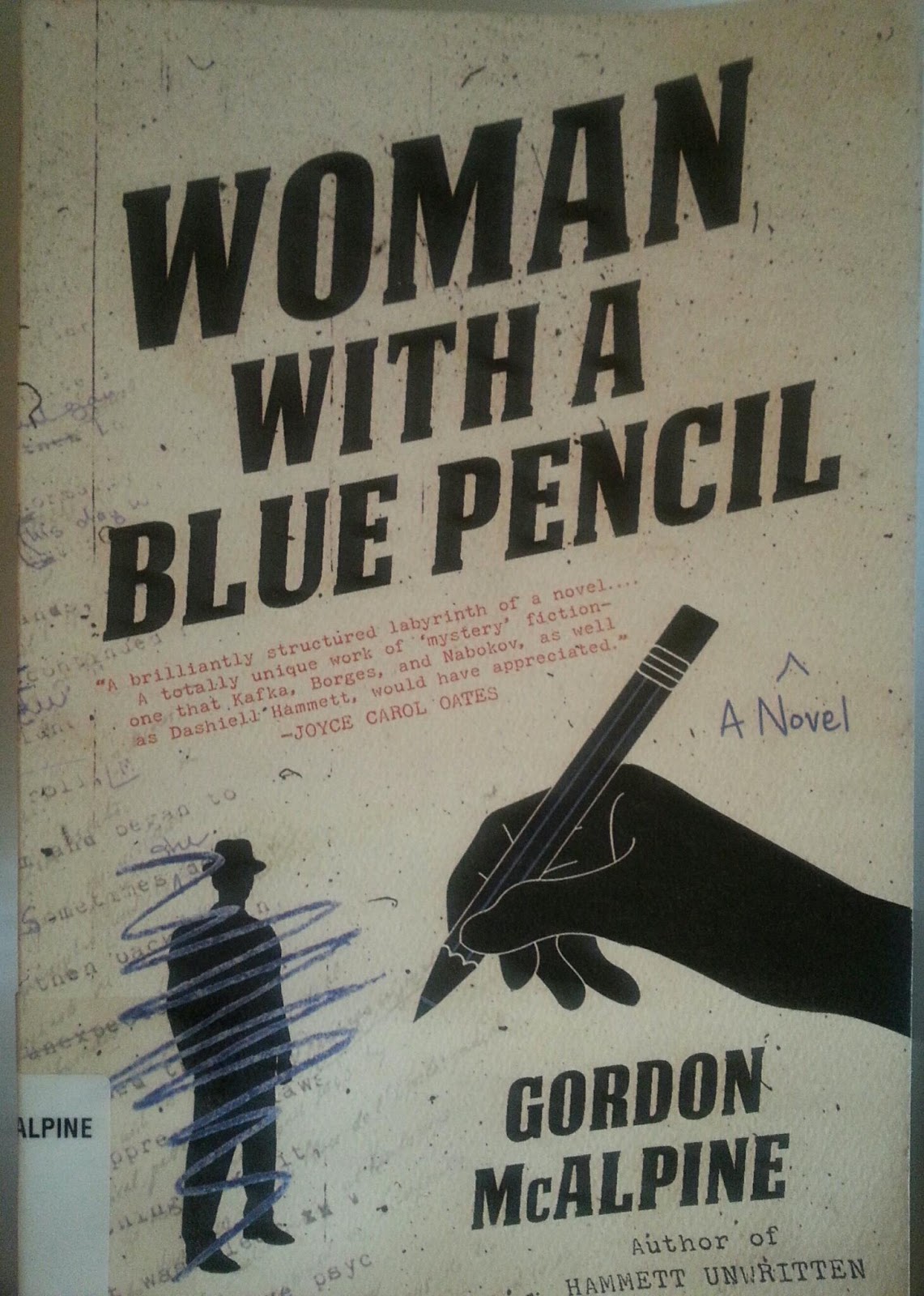
"Woman With A Blue Pencil" by Gordon McAlpine

Takumi Sato wanted to write a mystery novel about a grieving husband seeking his wife's lover/killer. His editor at the publishing house, Maxine Wakefield, would prefer a genre spy adventure about a secret agent tailing an assassin. Sam Sumida is a Japanese-American professor who fears he is losing his grip on reality: there is no record of his existence anywhere. Police detective Henry Czernicek is Sam's only connection to the world he remembers...but this guy is the man who was having the affair with Kyoko, Sam's wife..and is the man who killed her..maybe..a woman resembling Kyoko is running loose on the streets in a killing spree. In hot pursuit is Korean-American secret agent Jimmy Park, who hates being confused with Japanese by ignorant Whites, though is not particularly interested in identifying anything about Korean culture that would make him as distinctly different from a Japanese man (or any American man, for that matter) as he claims he is.

Gordon McAlpine - he wrote Hammett Unwritten under the pen-name "Owen Fitzwilliam - juggles all these characters and stories using mixed-narration and multiple realities. I'm reminded of Rosencrantz and Guildenstern Are Dead or "The Zeppo" episode of Buffy or The Lion King 1 & 1/2, where you have a separate story occurring in the background/periphery of a more commonly-known story brought up to the foreground. Takumi Sato, a 22 year-old Japanese-American man languishing in an internment camp during World War II, completes his manuscript for The Orchid and The Secret Agent per Maxine Wakefield's specifications, but only because he decides he will finish the story he really wanted to tell by having Sam and Henry find their footing in this forced, cardboard reality of a rubbish spy novel that Maxine manipulates Takumi into writing.

The book isn't perfect - the only characters that feel fleshed out are Sam and Henry..and perhaps the point of the book is that the characters with the most capacity for life get to finish their story. Jimmy Park is a secret agent/detective who accomplishes nothing beyond beating up a bunch of guys. Takumi Sato completes a book he didn't want to write, only because he found a way to complete the book he wanted to write, but felt doomed by circumstances surrounding him and saw no future in his current state. Maxine Wakfield got the novel she wanted to publish, but will never get to spin it into a series, because she twisted the arm of her writer too hard. Sam Sumida finally got revenge against his wife's killer, but his wife doesn't exist anymore and was revised into a twisted new character that is emphatically not the Kyoko he knew and loved. Only Henry Czernicek got what he deserved..even if what he deserved only mattered because it mattered to two different men living on two different panes of existence.

Even more impressive is how short the book is. There are a lot of high-concept novels out there that weigh a brick..and always read like something you've glanced at before on film or television. Not this. This was good.

Friday, October 14, 2016

"The Chocolate Falcon Fraud" by JoAnna Carl

This month marks the 75th anniversary of the 3rd adaptation of Dashiell Hammett's epic detective novel, The Maltese Falcon...the one with Humphrey Bogart and the statue of a bird. All kidding aside, The Maltese Falcon should rank among the top 2 greatest mystery novels of all time (the other being The Hound of The Baskervilles) and the film actually improves on it, particularly with the ending, which leaves out an additional scene in the book that sort-of cheapens our conclusions about the character of Sam Spade by implying that he's already over the drama, whereas the Bogart version of Spade is not likely to forget what happened after "..a couple of rough nights.." If you haven't seen it, please do.

Now...I realize the only surviving participant in the 1941 film is the prop falcon statue. There are two in existence. They both have aged to the point where they appear to be made of solid milk chocolate, in color and texture - like a chocolate bunny. Some replicas of this prop are gold-plated, so they resemble a solid chocolate falcon wrapped in gold foil..

With this train of thought in mind, it was easy for me to see the appeal of a mystery novel with a title that includes the words "Falcon" and "Chocolate". Right off the bat, I will say that there is no chocolate Maltese Falcon statue in the book, even though the protagonist specializes in designing original gourmet chocolate confections. The only chocolate falcons we get are described in a way that resembles those holiday chocolate candies Russell Stover offers - marshmallow-filled chocolates in the shape of Santa Claus, Halloween pumpkins and Easter eggs. These Falcon candies are offered by our heroine at a Maltese Falcon film festival/fan expo, a convention you might think would exist, given the popularity of the film, but is made-up for the plot of the book.

The Chocolate Falcon Fraud is a cozy - a sub-genre of mystery novel in which there's a puzzle to be solved, but it's not a tough puzzle; the real appeal is that the heroine (always a female protagonist; the closest you get to a male cozy detective series is M.C. Beaton's Hamish Macbeth novels and Lawrence Block's Bernie Rhoddenbar books, which are mostly classified as police procedural and caper novels, respectively, but Hamish is a constable in a cozy Highland village and Bernie's a thief that owns a shop, so they fit in there) runs a shop that makes gourmet chocolate with her aunt, so the author gets to better her books with recipes and trivia about fudge and chocolate foodstuffs for chocoholics. It could be adapted into a film for the Hallmark Movies and Mysteries channel. More on that in a bit, but getting back to what a cozy is...they're light in subject matter and not too explicit in violent content. It's Miss Marple and Murder, She Wrote territory, where a headline on the front page of the New York Daily News might actually read, "Murder Stymies Cops!"

Lee Woodyard is our eager amateur sleuth. Her stepson from a former marriage has come back into town to become the target of an elaborate kidnapping plot by a group of con artists baiting him with a ruse about a possible 3rd falcon prop statue used in the 1941 film that he wants to purchase. Doppelgangers for Sydney Greenstreet, Peter Lorre and Mary Astor show up. Gawdy keychain-size replicas of the falcon pop up. This is good stuff, but my big gripe (aside from the lack of a proper falcon statue made of solid milk chocolate) is that the cool Falcon riffs kick in halfway through the second half of this book. Most of what we get is teen soap opera about Jeff, the aforementioned stepson/scapegoat, whose transformation from ne'r-do-well emo teen punk to nerdy film buff/movie memorabillia tchotchke collector with a girlfriend is sincere...or if he's on the shenanigans.

The book is okay...but JoAnna Carl (a pseudonym used by Eve K. Sandstrom) dropped the ball by overlooking the most obvious gag a mystery novel with a title like that could have. It has a lot of nice ideas..I do wish there was a bigger fandom for The Maltese Falcon.

Should The Chocolate Falcon Fraud be adapted into a film for Hallmark Movies and Mysteries? Yeah! It would be terrific! I would like to suggest Danielle Harris play Lee Woodyard. I can easily picture her in a mystery involving a popular genre film, a fan convention and collectors and tchotchkes...and Will Wheaton could play her love interest, because Danielle's husband in real-life kind-of resembles Wheaton..if Wheaton was pumping iron a bit. And Jennifer Tilly could play Lee's Aunt Nettie, so yeah, this would be awesome.

And there will be a falcon statue made of solid milk chocolate..with marshmallow center, of course.