"The blog I always wanted to read." - Joseph Adorno, Creator & Author of Comic Book Rehab
Monday, June 15, 2020
Dennis O'Neil, RIP
Saturday, March 21, 2020
COVID-19 vs. Comic Books: "That's ALL, Folks"?!
Thursday, September 1, 2016
Mary Jane Watson: What Do WE Know?
If you're regarding the recent reveal that actress Zendaya Coleman had been cast as Mary Jane Watson in Spider-Man: Homecoming (or Michelle Jane Watson, but still "M.J." regardless) in terms of fidelity to the source material, then it probably is disappointing that Hollywood is still adverse to gingers..but Zendaya is an actress and glamorous model..and the Mary Jane Watson of the comics is an actress and glamorous model...she's as good a choice (perhaps a better casting choice) than the 2 actresses who preceded her (Kirsten Dunst and Shailene Woodley). And there's another thing to consider:
"Face it tiger, you hit the jackpot!"..is kind of a ridiculously corny thing a woman could say. The only actresses who could get away with saying that line just right - in all sincerity, without a trace of sarcasm or saccharine schmaltz - are Karen Gillan and Ellie Kemper, and they're not teenagers. Megan Fox could do it, because we've seen her play the M.J. all of you detractors think you want to see onscreen...in 4 Michael Bay movies (yes, I'm counting the TMNT movies). And I don't know if Bella Thorne could've delivered that line, either.
Past Spider-Man films tended to downplay M.J.'s personality to match the performance of their Spider-Man/Peter Parker. Dunst's M.J. could be noncommittal and fickle. Leaked dialogue for Woodley's deleted scenes appeared to portray Mary Jane as pragmatic and less of a party girl than the M.J. from Stan Lee and John Romita Sr.'s stories. In other words, she might've been characterized as having more in common with Peter, socially.
There's a superficial take on Mary Jane..and a more complex one. The superficial M.J. is...Megan Fox in a Transformers movie. I'm not going to waste words - if you want to see quintessential M.J. Watson, watch Megan Fox in the first 2 Transformers movies. That's Mary Jane in all but name only...yet lacking complexity.
The complex Mary Jane Watson is the one who became Peter's confidant..and eventually, his wife. She's the one who became the love of his life..first by staying by his side to help him with his grief after Gwen died. We haven't seen that M.J. depicted on film at all...maybe we will see Zendaya bring out that aspect of the character. That would be awesome.
Friday, April 1, 2016
#Top5ComicBooks of 2015 #1: "Amazing Spider-Man #1", Vol. 4
When I was a kid, I always thought Spider-Man was a rich guy. Those gadgets must cost serious money..no way could he afford an apartment (albeit a crappy one) in NYC by taking pictures of himself in costume for millionaire cheapskate J. Jonah Jameson; he'd be better-off shaking down tourists for tips after posing for free photos on Times Square with the other shabbily-dressed cosplayers. Plus, the toys always showed he owned a multitude of vehicles at his disposal - cars, motorcycles, jetplanes, helicopters..and he lives in Forest Hills!! Peter Parker, you rich, boy.
Let's be honest...Spider-Man was always a miserable read. Who gives this book to children? A guy who can't win because his life is doomed. Why can't he win? Why is Parker plagued with bad luck? Because he sucks. He was a sap..perhaps he is destined to remain a sap. At least he's a rich sap now. Money buys time, money pays bills, money pays ideas forward...better to have money and be a guy who inadvertently killed his girlfriend and got his marriage annulled by the Devil so that his 90-year-old Aunt could continue preparing meals for him than a guy with dick in the bank who inadvertently killed his girlfriend and got his marriage annulled by the Devil so that his 90-year-old Aunt could continue preparing meals for him...let him play Ted Kord for a while.
And a happy April Fools Day to everyone. :)
Monday, January 25, 2016
#Top5ComicBooks of 2015 - #4: "The Amazing Spider-Man: Renew Your Vows" by Dan Slott and Adam Kubert
Spider-Man...married? With child? That's the way Spider-Man comics should've continued, in my humble opinion. No crazy stalker-kidnappers, vampires, Gwen Stacy-Norman Osborn shippers, Iron Spidersuits and deals with Mephisto. Just stories about Marvel's greatest superhero defying his hard-luck existence by becoming a husband and father while continuing to fight the good fight using his unusual powers, intelligence, resourcefulness and wit, because that's what a responsible grown-up man does. THAT'S the real Peter Parker. That's the real Spider-Man.
And if it required a tie-in mini-series set in a parallel universe showcasing a preposterous new villain as part of a patchwork crossover to dust off this status quo and show what readers lost in favor of a bizarre, myopic, "not-on-my-watch" possessivenes on the part of higher-ups, so be it. It's only on the final page that Dan Slott hints that even he's aware that The Regent is an incredibly stupid villain whose m.o. has him miscast as a Spider-Man foe and he may have been working off an outline that was handed to him from editorial, but the dialogue between Peter, Mary Jane and Annie May Parker rings true in a way that many Spider-Man comics orbiting this mini-series haven't in almost two (!) decades. It ain't perfect, but it's the best I've seen or read with the webhead in a long time. My one regret is that this feels like the end - the "Whatever Happened To The Man of Tomorrow? "-esque execution has me suspect that Peter Parker will never be portrayed in this manner anywhere again. His default characterization will be either a teenager ( example: the new Spidey comic book series), or a late-twentysomething "millennial" sap.
Now if only we knew who is that kid in that one panel of issue #2...who is he looking at?
Thursday, June 18, 2015
"The 21st Century Superhero: Essays On Gender, Genre and Globalization In Film", Edited by Richard J. Gray II and Betty Kaklamanidou
It is possible to publish a book of essays about superhero movies without discussing the source material. That's what this book was, as well as offering an argument that the films made in the early-2000s had allusions to 9-11, the war in Iraq and American military action, all within a narrow margin...it feels like it had a limited sell-by date, with some discussions dated by their choice of films to examine ( it's been a long time since anyone talked much about Hancock, Aeon Flux or the Kick-Ass movies ), but there are some good tidbits:
*Bruce Banner's exile in Brazil's favelas, as depicted in The Incredible Hulk, piqued the author's interest more than the remaining 2/3 of the film ( so...somebody liked at least some of that movie ).
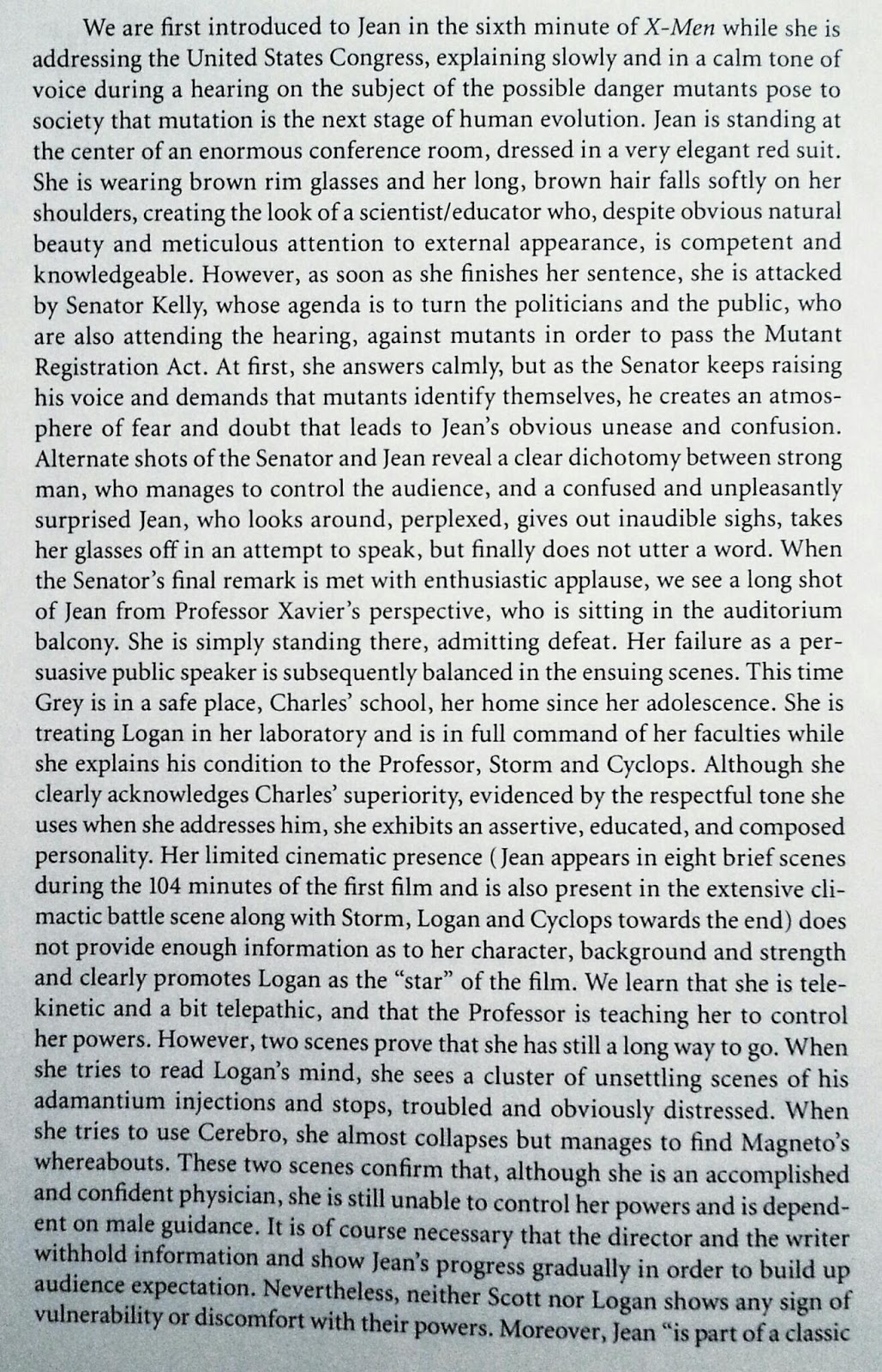
*Jean Grey's "..limited cinematic presence" in the original X-Men film trilogy is a reflection on "the mythos of patriarchy" in the films - in other words, she doesn't have enough screen time to develop into an interesting character..unless it's a character development that serves the mechanics of the script, i.e., everything centers around Professor X, Magneto, and especially Wolverine.
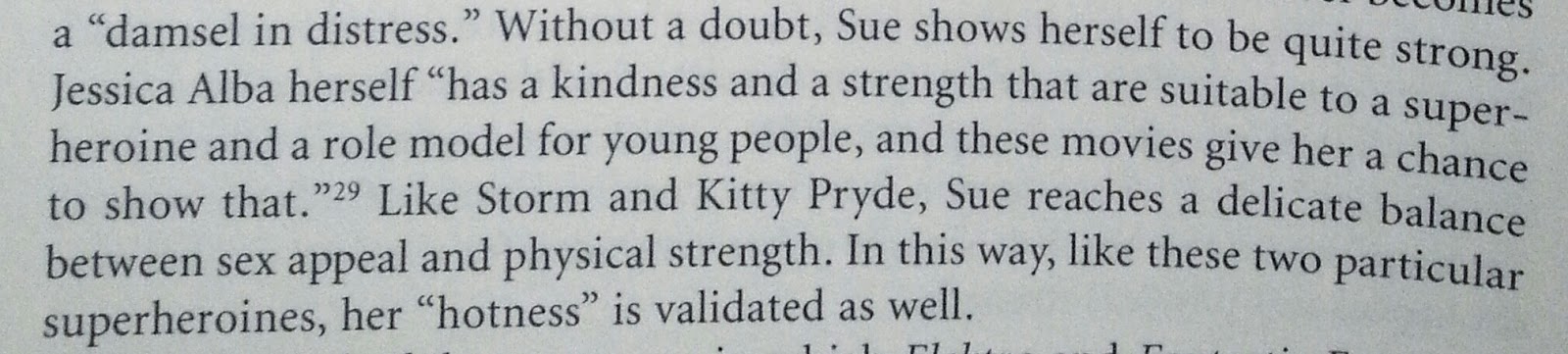
*In his efforts at "Understanding 'Hotness' in the superhero film genre", Richard J. Gray had quite a lot to say about Ellen Page's sex appeal as Kitty Pryde. Considering how she barely had about 15-20 minutes of screen time and the essay was focused on her debut in X-Men: The Last Stand...I say he was smitten with Page...she was appealing in Super, though nobody has ever written this much about her attractiveness since - far less was written about her coming out a while back. He also has a crush on Jessica Alba, since he seems to give her shrill, vapid Sue Storm in Fantastic Four a favorable review. Even Halle Berry's Catwoman gets a light love tap of criticism, so whether he wrote the essay to talk shop about attractive female superheroes and ponder why they were sexy or critique their sexualized image is moot.
*No surprise that several essays compared Christopher Nolan's work on Batman Begins and The Dark Knight as commentaries on life post-9/11, but what caught my eye was a shout out to Batman Unmasked, a book I reffered to in my previous blog post as a possible inspiration for Grant Morrison's take on Batman, even confirming my suspicion by noting the passage I vaguely remembered..so now I don't have to hunt for that out-of-print book just to check out a hunch!
*I've never read any of Marvel's Kick-Ass or seen the movies, so I wouldn't be able to agree or disagree if the films share a correlation with the Spider-Man movies in their contrasting use of voiceover narration reflecting the masculinity of their respective effete protagonists, but I do know that nobody's rallying for more sequels to Kick-Ass.
*I'm actually bored with reading material that puts Alan Moore and Dave Gibbons' Watchmen on a pedestal, because I don't really think it's the greatest comic ever written and drawn - I just respect the effort that the creators made at telling this story. I do agree with the essay in this book arguing that the film adaptation succeeded in being a pastiche of film noir, but that's what the comic book did, and Snyder was simply following it. It's hampered by the fact that it features an ensemble cast of also-rans, could've-beens and never-weres, so it feels like we're watching a big-budget made-for-cable mini-series on Starz or Reelz instead of a proper superhero adventure film.
So..the book essentially covers what I would argue was the formulative stage of modern superhero movies. If Avengers is being considered the definitive maturation of this genre and Tim Burton's Batman films the embryonic, then the films covered in this book premiering between 2000 and 2011 are formulative development...but that's my hypothesis. If the authors had thought of that, they would've cranked out two sequel books of essays by now..
Monday, May 4, 2015
Catching Up: #FourComics...That I Read In The 2000s
"None of these people have anything interesting to say and none of them can write, not even Mr. Kerouac...it isn't writing at all - it's typing." - Truman Capote, attacking "Beat Generation" writers, circa 1959.
There's some overlap from the late-90s through that first decade beginning with 2000. I recall being willing to give anything a try. I wasn't just looking at what was on the racks now, but going backwards...I was interested in the early-80s Batman villainess, Nocturna...I still can't figure out what her deal was..what did she want?..I checked out the "Clone Saga" in Spider-Man comics, old Marvel Comics' Further Adventures of Indiana Jones...then there's Ebay - before PayPal butted in, that site was the place for stuff - I remember buying a lot of 50 Jughead comics, simply because I was interested in Trula Twyst and the comic shops never really have a good supply of Archie-related back issues...even with the spike from the Afterlife With Archie books.
And "Bendis!" - we can't reminisce about the early-2000s without mentioning Brian Michael Bendis...he wasn't the first writer to use what's now referred to as decompressed scripting, which is really just trimming the purple prose narration and thought balloons in favor of dialogue conveying suspense & tension, then stretching out plotlines over the course of multiple issues what would've once only taken 2 to tell. His approach would make multitasking on scripts a snap, allowing any writer following his lead to write "X" amount of pages for multiple titles...the books were becoming faster reads, but the price point was getting higher..as the trade paperback reprints were being cranked out, faster than ever before, you can't help staring and comparing: I could save money and buy a different comic, then read the trade when it's available to borrow at the public library, or buy the trade if I liked it after reading the library copy, or read the library copy to decide which issues from the storyline it collected I would go back and buy from the shop's back issues and save money that way..new options present themselves..
But is any of this stuff good? - that's why I copied that quote and posted it at the top of this post. The decompressed approach feels more like a change of format than a storytelling style; if you feel like you've read the book while briefly flipping through it, standing in front of the rack at the shop, then it's not something you're reading..it's something that's been cranked out, building to a moment / event...then setting up another moment / event.
So I start getting picky...I become familiar with the concept of walking out empty-handed...that's not fun, but it is what it is.
My favorite issue of Savage Dragon has the titular character mulling over an offer to have a comic book spun-off from his memoir. It gives Erik Larsen a chance to go meta and comment on superhero comics, circa 2003. At the time, Captain Underpants was a very popular children's book series, outselling the superhero comics...and Larsen was toying with the idea of offering a syndicated "Savage Dragon" newspaper comic strip which would have a lighter tone and crossover with the regular series. This experiment lasted 2 or 3 issues (of which this was one of them). The one lasting element was Mr. Glum, the pint-sized villain of the arc - a combination of The Brain from Pinky and The Brain and Stewie Griffin from Family Guy - he's become a recurring foe ever since.
Justice League Adventures was the tie-in to Cartoon Network's Justice League, then in it's first season. The show wasn't popular until it was retooled in it's 3rd season as Justice League Unlimited, but this issue, featuring a menagerie of DC Comics supervillians unwittingly invited to a sting operation organized by the League, is incredibly clever and a lot of fun. This is the comic book script that put Dan Slott on the fast track to writing more material on the 1st tier for Marvel and DC.
I'm one of those fans rooting for Ted Kord to officially be "back" as the Blue Beetle. That current Convergence tie-in is a good read, so Scott Lobdell has my vote for a new ongoing series starring Ted...
..and now I'll write about the book that killed him off. 80 pages of comics for one dollar is a steal, and the mystery of whose corpse Batman was cradling in his arms on that Alex Ross & Jim Lee cover had people guessing for months. Countdown To Infinite Crisis became the definitive Ted Kord tale in showcasing his perseverance in the face of all his friends and allies behaving out of character in order to hype an upcoming crossover that was overshadowed by the events that set it up. We had just seen Sue Dibney get raped by Dr. Light in Identity Crisis, Jason Todd back from the dead in Batman and Ted Kord get shot in the head by Maxwell Lord...we were too shell-shocked to care what Lex Luthor was up to.
And that cover, more than any image I've seen since, encapsulates Batman's eclipsing popularity over Superman in the new decade perfectly.
Spider-Girl had lasted for a decade in spite of it being anachronistic to Marvel Comics then-editor-in-chief, Joe Quesada. Let's not be naive: he co-wrote and illustrated "Spider-Man: One More Day" and wrote "Spider-Man: One Moment In Time"; if a married Spider-Man wasn't his cup of tea, why would he like a book about his daughter? It may have helped prolong the life of the book when it was retooled with a new title, The Amazing Spider-Girl, but it's future in the face of a Brand New Day was unlikely. This issue, #28, has May Parker take stock of her existence amidst storylines wrapping up, like the penultimate episode of an adventure series that's going to leave it's audience wanting more. It was a class act from beginning to end.
And in 2025 my " #FourComics..That I Read In The 2010s" should be all sorted out...