Showing posts with label Marvel Comics. Show all posts

Monday, January 28, 2019

"#Adulting" or "#Kidding"?

I don't feel like quoting Bill Maher, because that's like quoting from the court jester. His remarks on the reaction to the death of Stan Lee and subsequent follow-up to the public reaction to his reaction...It's all done in jest. His shots at Kevin Smith are also entirely in jest, since Smith is a funny cat in his own way. Both these clowns are for sale and not ashamed of it. They live quite well.


I'm more impressed with the eloquence of "Adulting", the essay by Maher that got the ball rolling. It's just three paragraphs. One page of notebook paper. And this essay will likely not be done in three. If Stan Lee's legacy is, according to Bill, that he created characters that appear in movies and put buns in theater seats, then the legacy of this "dumb culture" is that it kept big-budget movies in business. Quite an accomplishment from comic books being a medium born as a money-laundering front by gangsters shipping loads of booze, drugs & cash back-and-forth via a Canadian printing company.


If you've ever been keen to learn the history of the comic book "industry" and understand why it's got the social stigma that it has, then you're aware that the bulk of comic books in existence are trash. Bill Maher is right, but everyone hates it when he seems to be saying that adults should stop reading comic books because...the only people buying comics in the 21st century are adults. Kids and teenagers are more likely saving money to pay their phone bills. Adults are the only ones in the shops spending thirty or forty dollars a week buying comics until their piggy banks have been smashed, then the comic shops hope a new generation steps in to begin spending after the last one quits. This is not casual spending. The worst excesses of the medium that we saw in the 1990's - variant covers, crossovers, redundant characters, watered-down concepts, diluted brands, price increases, relaunches - keep popping up...because they still work. If there's any "good stuff" amongst that, well, that's nice, but the gimmicks keep the business afloat so that some good stuff can be found...you take what you can get, you read what you like, avoid the stuff you don't care about, know when to take a break, or know when to walk away. It's not going to get better if you collect 'em all. It's all junk. But it can be good junk.


The consumers who still hang in there? You'll find they're not buying as much.


In the past, Will Eisner tried passing off comic book illustration in technical terms as "Graphic Storytelling"...which would've taken off if he was actually any good at writing dialogue. I'm convinced Carl Barks was the only Golden Age-era cartoonist who knew how to write, but his work is marginalized because it's Donald Duck and Uncle Scrooge, which shouldn't make a difference in distinguishing it as excellent storytelling in the medium, but that's not an opinion shared by people only looking at the superhero books. If comic books are ever going to get respect as an art form (and it seems awfully late in the game to bother thinking about this...this is all bull $#!+ in it's own way - always has been), then any talk of it needed to be more democratic..and, unfortunately, that ship sailed a long time ago. There's a lot of trash disguised as treasure. It's been that way for over 80 years, so Bill's just repeating what everyone's mother used to say from under his smirking stance.


Regardless of what anyone thinks about the quality of comic books, I don't recall anyone who's ever read them say they wasted their time. But it was never an activity that people own up to doing with dignity, as it's stuck with the stigma of being the stuff of misguided adolescence...and adults who've become attached to it by habit. It's not going to be taken seriously. It can't be.


And there's always talk that it's almost over.


It's like the old saying: Even a broken clock can tell the correct time twice a day.

Wednesday, May 4, 2016

#Top5ComicBooks of 2015 - #3: "All-New Hawkeye" by Jeff Lemire and Ramon Perez

I delayed posting this entry on my list of the "Top 5 Comics of 2015" because I wanted to see how the current storyline in All-New Hawkeye was going to wrap. Surprise, surprise..the end of the arc marked the end of the book. Bittersweet, since it's not clear if Hawkeye will ever be the same.

Let me make this perfectly clear: Clint Barton - Hawkeye - is the coolest superhero in current comic books produced right now. Take a good look at what's currently on the stands these days; all the members of the cape and cowl set are serving as pawns of storylines on the whim of their respective writers. Hawkeye, on the other hand, has managed to quietly function within the successful status quo launched by Matt Fraction in 2012. Even though he's purely a fictional character, he has stayed in character, so in a way, he's solid. His adventures have a feel. They matter. He still wears that hearing aid from using a "sonic arrow" back in the Mark Gruenwald mini-series, and he's cool with it. He has no superpowers and resides in a tumbledown apartment building, but it's his home. He's got that smart cool dog that likes pizza. He's even cool with letting his protege Kate share his superhero moniker rather than diminish it with "Hawkette" or "Lady Hawkeye". His brother stole his fortune in cash, but he was willing to turn the other cheek after learning that the bum had turned fairy godfather/boyfriend to a harried single mother living in Clint's building, wisking her family with him to a newly-bought island haven. Spider-Man would bitch and moan about these "indignities" to no end; Clint took them on the chin and looked all the more heroic for it. He moves forward.

And if the future foretell a new status quo that pulls him away from what felt like a cozy haven from the noise of mainstream superhero funnybooks, then it did its part.

I actually liked Lemire's run better than the Fraction's. True, one era couldn't have occurred without the other, but I never liked the Track Suit Mob or The Clown much. What I did enjoy was everything else. All-New Hawkeye gives us more of the everything else while building up the iconography of Clint Barton and Kate Bishop by digging into their respective pasts with the three arcs that comprise all 11 issues of the series. Wunderkammer, the longest installment, sets up the main adventure about the rescue of three genetically modified children with distructive psychokinetic powers wanted by S.H.I.E.L.D. and Hydra while elaborating on Clint's childhood with his brother Barney as they were taken under the wing of their mentor, The Swordsman. The Bishop's Man documents a possible future in which both Hawkeyes are still plagued with guilt about their failure to save these kids - Clint never really moved on, while Kate became preoccupied with getting her house in other, both leading colorful, but empty existences. The final arc, Hawkeyes, depicts the rescue mission, the fate of the three kids and flashbacks to Kate's childhood, raised by her shady tycoon father, who will likely be the main adversary of the Hawkeyes in a future arc.

We also get the return of Barney Barton, Clint's brother. I like this character and his bizzaro evolution along the periphery of the Marvel Universe: he began as Clint's foil, a ne'r do well older brother who morphed into a teetotaler secret agent, then morphed into supervillain Trickshot before reverting back into a ne'r do well who loved freeloading and playing crossword puzzles and ultimately stealing his brother's fortune...for a good cause...well, it worked out that way - he did help with the assault on Clint's building by all those gangsters.

The letter page in the last issue hinted that "big things" were in store...I'm not sure what they could be...maybe Clint marries Kate and buys a farmhouse...it's comics. Even though this is emphatically not the same Hawkeye depicted in film and cartoons, his is not entirely dissimilar in characterization...perhaps less inspired then the Clint of these recent comics. And definitely not as cool. If you have never read this series, I do recommend that you give it try.

Friday, April 1, 2016

#Top5ComicBooks of 2015 #1: "Amazing Spider-Man #1", Vol. 4

When I was a kid, I always thought Spider-Man was a rich guy. Those gadgets must cost serious money..no way could he afford an apartment (albeit a crappy one) in NYC by taking pictures of himself in costume for millionaire cheapskate J. Jonah Jameson; he'd be better-off shaking down tourists for tips after posing for free photos on Times Square with the other shabbily-dressed cosplayers. Plus, the toys always showed he owned a multitude of vehicles at his disposal - cars, motorcycles, jetplanes, helicopters..and he lives in Forest Hills!! Peter Parker, you rich, boy.

Let's be honest...Spider-Man was always a miserable read. Who gives this book to children? A guy who can't win because his life is doomed. Why can't he win? Why is Parker plagued with bad luck? Because he sucks. He was a sap..perhaps he is destined to remain a sap. At least he's a rich sap now. Money buys time, money pays bills, money pays ideas forward...better to have money and be a guy who inadvertently killed his girlfriend and got his marriage annulled by the Devil so that his 90-year-old Aunt could continue preparing meals for him than a guy with dick in the bank who inadvertently killed his girlfriend and got his marriage annulled by the Devil so that his 90-year-old Aunt could continue preparing meals for him...let him play Ted Kord for a while.

And a happy April Fools Day to everyone. :)

Monday, January 25, 2016

#Top5ComicBooks of 2015 - #4: "The Amazing Spider-Man: Renew Your Vows" by Dan Slott and Adam Kubert

Spider-Man...married? With child? That's the way Spider-Man comics should've continued, in my humble opinion. No crazy stalker-kidnappers, vampires, Gwen Stacy-Norman Osborn shippers, Iron Spidersuits and deals with Mephisto. Just stories about Marvel's greatest superhero defying his hard-luck existence by becoming a husband and father while continuing to fight the good fight using his unusual powers, intelligence, resourcefulness and wit, because that's what a responsible grown-up man does. THAT'S the real Peter Parker. That's the real Spider-Man.

And if it required a tie-in mini-series set in a parallel universe showcasing a preposterous new villain as part of a patchwork crossover to dust off this status quo and show what readers lost in favor of a bizarre, myopic, "not-on-my-watch" possessivenes on the part of higher-ups, so be it. It's only on the final page that Dan Slott hints that even he's aware that The Regent is an incredibly stupid villain whose m.o. has him miscast as a Spider-Man foe and he may have been working off an outline that was handed to him from editorial, but the dialogue between Peter, Mary Jane and Annie May Parker rings true in a way that many Spider-Man comics orbiting this mini-series haven't in almost two (!) decades. It ain't perfect, but it's the best I've seen or read with the webhead in a long time. My one regret is that this feels like the end - the "Whatever Happened To The Man of Tomorrow? "-esque execution has me suspect that Peter Parker will never be portrayed in this manner anywhere again. His default characterization will be either a teenager ( example: the new Spidey comic book series), or a late-twentysomething "millennial" sap.

Now if only we knew who is that kid in that one panel of issue #2...who is he looking at?

Thursday, June 18, 2015

"The 21st Century Superhero: Essays On Gender, Genre and Globalization In Film", Edited by Richard J. Gray II and Betty Kaklamanidou

It is possible to publish a book of essays about superhero movies without discussing the source material. That's what this book was, as well as offering an argument that the films made in the early-2000s had allusions to 9-11, the war in Iraq and American military action, all within a narrow margin...it feels like it had a limited sell-by date, with some discussions dated by their choice of films to examine  ( it's been a long time since anyone talked much about Hancock, Aeon Flux or the Kick-Ass movies ), but there are some good tidbits:

*Bruce Banner's exile in Brazil's favelas, as depicted in The Incredible Hulk, piqued the author's interest more than the remaining 2/3 of the film ( so...somebody liked at least some of that movie ).

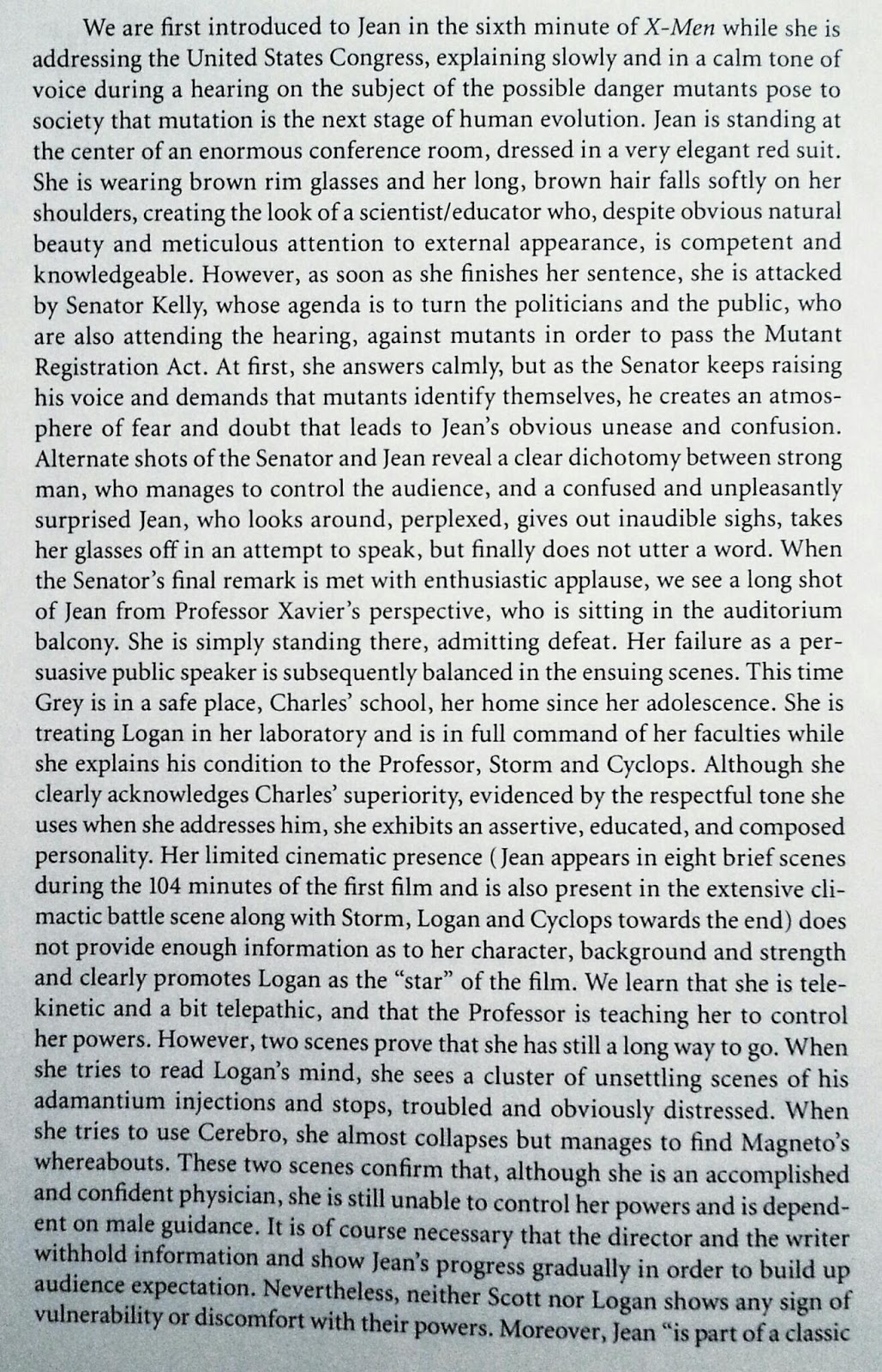
*Jean Grey's "..limited cinematic presence" in the original X-Men film trilogy  is a reflection on "the mythos of patriarchy" in the films - in other words, she doesn't have enough screen time to develop into an interesting character..unless it's a character development that serves the mechanics of the script, i.e., everything centers around Professor X, Magneto, and  especially Wolverine.

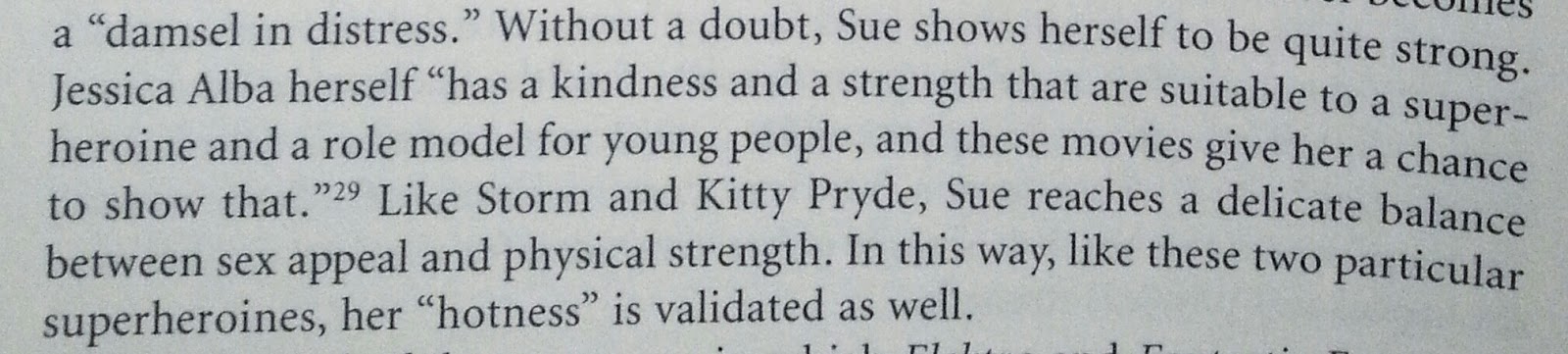
*In his efforts at "Understanding 'Hotness' in the superhero film genre", Richard J. Gray had quite a lot to say about Ellen Page's sex appeal as Kitty Pryde. Considering how she barely had about 15-20 minutes of screen time and the essay was focused on her debut in X-Men: The Last Stand...I say he was smitten with Page...she was appealing in Super, though nobody has ever written this much about her attractiveness since - far less was written about her coming out a while back. He also has a crush on Jessica Alba, since he seems to give her shrill, vapid Sue Storm in Fantastic Four a favorable review. Even Halle Berry's Catwoman gets a light love tap of criticism, so whether he wrote the essay to talk shop about attractive female superheroes and ponder why they were sexy or critique their sexualized image is moot.

*No surprise that several essays compared Christopher Nolan's work on Batman Begins and The Dark Knight as commentaries on life post-9/11, but what caught my eye was a shout out to Batman Unmasked, a book I reffered to in my previous blog post as a possible inspiration for Grant Morrison's take on Batman, even confirming my suspicion by noting the passage I vaguely remembered..so now I don't have to hunt for that out-of-print book just to check out a hunch!

*I've never read any of Marvel's Kick-Ass or seen the movies, so I wouldn't be able to agree or disagree if the films share a correlation with the Spider-Man movies in their contrasting use of voiceover narration reflecting the masculinity of their respective effete protagonists, but I do know that nobody's rallying for more sequels to Kick-Ass.

*I'm actually bored with reading material that puts Alan Moore and Dave Gibbons' Watchmen on a pedestal, because I don't really think it's the greatest comic ever written and drawn - I just respect the effort that the creators made at telling this story. I do agree with the essay in this book arguing that the film adaptation succeeded in being a pastiche of film noir, but that's what the comic book did, and Snyder was simply following it. It's hampered by the fact that it features an ensemble cast of also-rans, could've-beens and never-weres, so it feels like we're watching a big-budget made-for-cable mini-series on Starz or Reelz instead of a proper superhero adventure film.

So..the book essentially covers what I would argue was the formulative stage of modern superhero movies. If Avengers is being considered the definitive maturation of this genre and Tim Burton's Batman films the embryonic, then the films covered in this book premiering between 2000 and 2011 are formulative development...but that's my hypothesis. If the authors had thought of that, they would've cranked out two sequel books of essays by now..

Monday, May 4, 2015

Catching Up: #FourComics...That I Read In The 2000s

"None of these people have anything interesting to say and none of them can write, not even Mr. Kerouac...it isn't writing at all - it's typing." - Truman Capote, attacking "Beat Generation" writers, circa 1959.

There's some overlap from the late-90s through that first decade beginning with 2000. I recall being willing to give anything a try. I wasn't just looking at what was on the racks now, but going backwards...I was interested in the early-80s Batman villainess, Nocturna...I still can't figure out what her deal was..what did she want?..I checked out the "Clone Saga" in Spider-Man comics, old Marvel Comics' Further Adventures of Indiana Jones...then there's Ebay - before PayPal butted in, that site was the place for stuff - I remember buying a lot of 50 Jughead comics, simply because I was interested in Trula Twyst and the comic shops never really have a good supply of Archie-related back issues...even with the spike from the Afterlife With Archie books.

And "Bendis!" - we can't reminisce about the early-2000s without mentioning Brian Michael Bendis...he wasn't the first writer to use what's now referred to as decompressed scripting, which is really just trimming the purple prose narration and thought balloons in favor of dialogue conveying suspense & tension, then stretching out plotlines over the course of multiple issues what would've once only taken 2 to tell. His approach would make multitasking on scripts a snap, allowing any writer following his lead to write "X" amount of pages for multiple titles...the books were becoming faster reads, but the price point was getting higher..as the trade paperback reprints were being cranked out, faster than ever before, you can't help staring and comparing: I could save money and buy a different comic, then read the trade when it's available to borrow at the public library, or buy the trade if I liked it after reading the library copy, or read the library copy to decide which issues from the storyline it collected I would go back and buy from the shop's back issues and save money that way..new options present themselves..

But is any of this stuff good? - that's why I copied that quote and posted it at the top of this post. The decompressed approach feels more like a change of format than a storytelling style; if you feel like you've read the book while briefly flipping through it, standing in front of the rack at the shop, then it's not something you're reading..it's something that's been cranked out, building to a moment / event...then setting up another moment / event.

So I start getting picky...I become familiar with the concept of walking out empty-handed...that's not fun, but it is what it is.

My favorite issue of Savage Dragon has the titular character mulling over an offer to have a comic book spun-off from his memoir. It gives Erik Larsen a chance to go meta and comment on superhero comics, circa 2003. At the time, Captain Underpants was a very popular children's book series, outselling the superhero comics...and Larsen was toying with the idea of offering a syndicated "Savage Dragon" newspaper comic strip which would have a lighter tone and crossover with the regular series. This experiment lasted 2 or 3 issues (of which this was one of them). The one lasting element was Mr. Glum, the pint-sized villain of the arc - a combination of The Brain from Pinky and The Brain and Stewie Griffin from Family Guy - he's become a recurring foe ever since.

Justice League Adventures was the tie-in to Cartoon Network's Justice League, then in it's first season. The show wasn't popular until it was retooled in it's 3rd season as Justice League Unlimited, but this issue, featuring a menagerie of DC Comics supervillians unwittingly invited to a sting operation organized by the League, is incredibly clever and a lot of fun. This is the comic book script that put Dan Slott on the fast track to writing more material on the 1st tier for Marvel and DC.

I'm one of those fans rooting for Ted Kord to officially be "back" as the Blue Beetle. That current Convergence tie-in is a good read, so Scott Lobdell has my vote for a new ongoing series starring Ted...

..and now I'll write about the book that killed him off. 80 pages of comics for one dollar is a steal, and the mystery of whose corpse Batman was cradling in his arms on that Alex Ross & Jim Lee cover had people guessing for months. Countdown To Infinite Crisis became the definitive Ted Kord tale in showcasing his perseverance in the face of all his friends and allies behaving out of character in order to hype an upcoming crossover that was overshadowed by the events that set it up. We had just seen Sue Dibney get raped by Dr. Light in Identity Crisis, Jason Todd back from the dead in Batman and Ted Kord get shot in the head by Maxwell Lord...we were too shell-shocked to care what Lex Luthor was up to.

And that cover, more than any image I've seen since, encapsulates Batman's eclipsing popularity over Superman in the new decade perfectly.

Spider-Girl had lasted for a decade in spite of it being anachronistic to Marvel Comics then-editor-in-chief, Joe Quesada. Let's not be naive: he co-wrote and illustrated "Spider-Man: One More Day" and wrote "Spider-Man: One Moment In Time"; if a married Spider-Man wasn't his cup of tea, why would he like a book about his daughter? It may have helped prolong the life of the book when it was retooled with a new title, The Amazing Spider-Girl, but it's future in the face of a Brand New Day was unlikely. This issue, #28, has May Parker take stock of her existence amidst storylines wrapping up, like the penultimate episode of an adventure series that's going to leave it's audience wanting more. It was a class act from beginning to end.

And in 2025 my " #FourComics..That I Read In The 2010s" should be all sorted out...

Thursday, August 14, 2014

The Magrs Method of Book Reporting: "Comic Wars: How Two Tycoons Battled Over The Marvel Comics Empire - And Both Lost" by Dan Raviv

Encapsulate the plot of this book in one sentence?
The financial woes in the 1990s of Marvel Entertainment Group - the corporate entity behind Marvel Comics - is explained.
When was this book published?
2002. This was a 1st edition hardcover in great shape that I bought at a comic shop for 5 bucks.
What's your verdict?
I remember reading a library copy of this book around the time of it's release;  obviously, it's past its sell-by-date, because Marvel's fortunes have improved: it's part of the Walt Disney Company, it's film adaptations of their comics are box office smashes ( some more than others, to be honest )...who cares that it was faring poorly in the 90s? The past is dead!
...
I found it interesting that none of the financial wizards fighting for control of the company were into comics* - and that's why I found this book hard to enjoy: the author tried to make the events surrounding Marvel's leadership woes into a Wall Street/Wolf of Wall Street - esque caper, but there was no real hustle or careers at stake; sure, people got laid off, but the principals in this escapade - Ronald Perelman, Carl Icahn, Ike Perlmutter and Avi Arad - were never at risk of losing their fortunes and being put out on the street; this was all part of the game - Marvel Comics was just a pawn on a large chessboard.
The book reveals that Perelman was only interested in acquiring Marvel because of it's potential as a character licensing company, putting the characters on films, TV series and merchandise;  when he learned, after buying the company, that the merchandising, film and television rights were already tied up, he began using the company as a platform for selling junk bonds and acquiring other companies that could correspond with Marvel's product licensing. There was nothing wrong with that - hoarding companies is a common practice.  Is it a good idea? Well, you end up forming a conglomerate when you do that, and any failure within the conglomerate can create a domino effect that can bring it down to its knees. Perelman acquired the trading card companies Fleer and Skybox,  the sticker company Panini, the distribution company Heroes World, and small-time rival Malibu Comics Entertainment ( only, the book reveals,  because that company had developed a computer coloring system that could be run twenty-four hours a day for faster production ), and a controlling interest in a toy company, Toy Biz, which meant Marvel now had a stake in the toy-making industry.
And the comics were not selling well.
HOWEVER...
The book strongly implies that the company would've been headed for bankruptcy even if their comics sold well. The cause of Marvel's bankruptcy had nothing to do with overprintings of X-Men#1 and bad Spider-Man comics ( and depending on who you're asking, they're still making awful comics with those characters ).
Perelman's initial goal to push Marvel into licensing was actually a good idea - they've been doing it for the past decade, even beginning aggressive campaigns to get back the film rights to characters/franchises that were sold to other studios. This book is really an artefact representing a finger-pointing attitude people held during the late-1990s, when they were looking for someone to blame for why the medium almost died.
Do you plan to keep this book?
I'm not sure - it is like one of those old gimmick comic books from the 80s and 90s that promoted an event that was eventually revised and negated a decade later - it's claiming everything Perelman did was wrong, yet the current owners are doing the same thing, so it's okay, right? ...
Or perhaps there's gonna be a Crisis...
Can you give us a good quote?
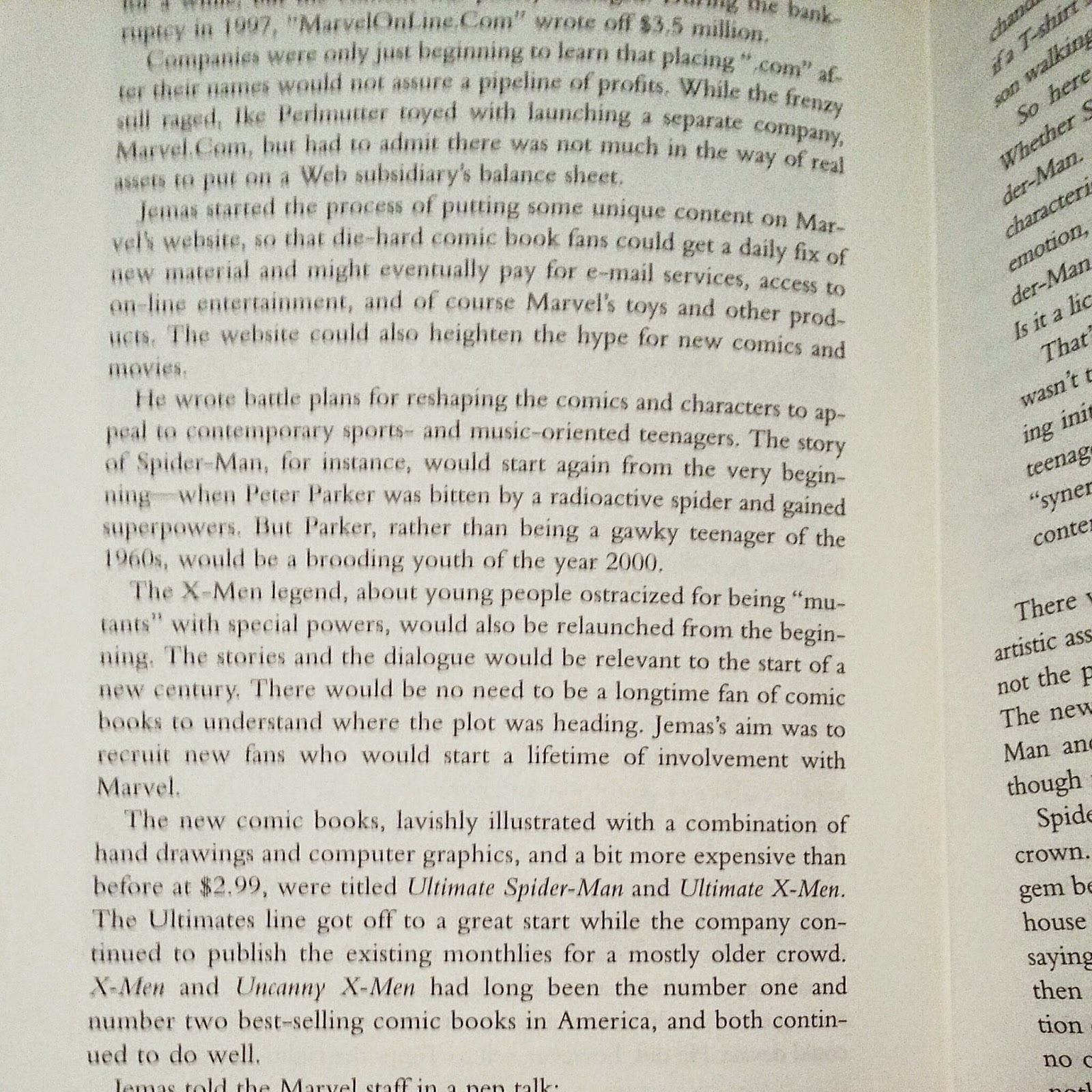
Sure. Check out the gallery below.
*actually, Avi Arad comes off as the only figure in the debacle who COULD have feelings about the source material behind the toys, t-shirts, video games and screenplays being cranked out, which explains why he is a major player in Marvel's current corporate hierarchy - after all, SOMEBODY in that boardroom has got to know what a "Spider-Man" is!

Tuesday, March 18, 2014

The Magrs Method of Book Reporting: "Spider-Man: The Darkest Hours" by Jim Butcher

Encapsulate the plot of this book in one sentence?

Kinfolk of Morlun - Spider-Man's deceased vampiric foe - have arrived in New York City to avenge their dead brother and have Spidey in their sights.

When and where did you get this book?

I saw a mass-market paperback edition in a comic shop and checked the public library to see if they had a copy, because of the author involved. They did. So I borrowed it from the library.

What year or edition?

2006 Trade Paperback. First edition. Larger size, easy-to-read print. Perfect.

Did you finish it?

I almost bailed out when I realized Butcher had written a direct sequel to a story arc from a time in Spider-Man continuity - when J. Michael Straczyinski was writing Amazing Spider-Man - that I'm not a fan of. Thankfully,  Butcher has his own voice and provides all the backstory you need in entertaining ways, so the book is accessible.

What's your verdict?
Butcher gets Spider-Man - the characterization, the consistency of the street-level feel to his adventures and interactions with other characters,  which is surprisingly tricky, because a lot of comic book writers and artists often complained about the Spider-Man of this era: his marriage to Mary Jane Watson was considered a drawback,  but Butcher handles it far better than the comics did at that time. I would suggest Marvel have Butcher write Spider-Man comics sometime soon. He's that good. And that's what made me want to finish reading the book - it reminded me of why I used to follow Spider-Man's adventures closely. This was my Spider-Man: smart, resourceful,  clever, witty, cool and wise beyond his years.

What surprises did it hold - if any?

The book is narrated in the first-person by Spider-Man, which is interesting - it more closely captured the feel of the comics. Superhero prose novels are often narrated in third-person.  Also, the number of guest-stars in what feels like a simple adventure (it's Rio Bravo with Spider-Man, really): Black Cat, the Rhino, Doctor Strange - all in major supporting roles, but depicted casually, as being a normal part of Spider-Man's world, which they are, depending on whoever's writing for him.

Which scenes will stay with you? Which characters will stay with you?

Butcher's take on Felicia Hardy (The Black Cat) and The Rhino will stay in my head as fully-realized characters for the first time. Spidey's on-and-off relationship with Felicia was always the one that set off the most sparks (at one point, her character was considered as having more depth than DC Comics' Catwoman, who was more one-dimensional, until the latter character was fleshed out more and then Felicia's characterization became increasingly one-dimensional). And the Rhino, Doctor Strange and Wong - Strange's major domo - seem definitive here. Also, Mary Jane Watson Parker, wife of Spider-Man,  is given a fairer shake than the comics at that time (Marvel Editor-in-chief Joe Quesada had compromised  that character and Spider-Man badly with his edicts to end their marriage). However, in retrospect,  none of Peter Partner's romances ever seemed like a true meeting of the minds...maybe he should try a romance with Spider-Woman, or would that be too obvious?

One other surprise: the adventure never feels overblown or out-of-scale for Spider-Man.  Butcher is well aware that Morlun is a vampire in all but name only, and the only weakness of the book lies in the fact that Mortia and the Ancients seem like cardboard villains from Blade or Underworld, but that fault lies with the source material he's playing off.

What genre would you say it is?

Urban Fantasy-Adventure, though that seems to make it bigger, doesn't it?

Have you read anything else by this author?

Jim Butcher is best known for The Dresden Files series of novels, which I haven't read; they're usually twice as long and I'll have to check it out sometime to see if there's an installment that appeals to me.

Is it available today?

It might not be in print, but it's not hard to find.

Give me a good quote.

Sure - check out the scans below. As a bonus, I found a photo of cosplayer Soni Aralynn dressed as The Black Cat in a Spider-Man costume, a scene that does occur in the book! Did she know? Had she read it? I don't know, but it's a cool coincidence!